Liked this post? Share with others!
Revenue Cycle Management (RCM) is the process of managing the revenue of a healthcare practice from end to end. It starts when a patient schedules an appointment and ends when the practice receives full payment for the medical services provided. It includes every financial step of the patient journey, including patient registration, insurance verification, medical coding, claim submission, payment posting, denial management, and patient collections. When the revenue cycle is not managed properly, small mistakes related to coding and claim denials can occur at different stages. This disrupts the payment flow, and during the process, revenue leakage begins.
Basically, revenue leakage means when a healthcare practice loses money that it has already earned but fails to collect completely or on time. These small losses, over the long term, can result in major revenue loss. As per recent reports, hospitals lost over $48 billion in 2025 due to claim denials and unpaid patient balances. That number is insane. Revenue leakage in revenue cycle management can happen due to many reasons, such as growing weak KPI tracking, insurance complexity, operational fatigue, administrative burdens, and other workflow inefficiencies. According to CAQH Index data, administrative workload, eligibility verification, and claim tracking consume a major amount of operational time, which can eventually contribute to revenue leakage.
Many studies suggest that more than 90% of claim denials can be prevented if medical practices maintain proper follow-ups and actively track every pending payment. That is why we at Amfac Medical Management specialize in Revenue Cycle Management optimization and revenue leakage prevention, focusing on maximizing collections and helping practices recover more than 98% of their revenue.
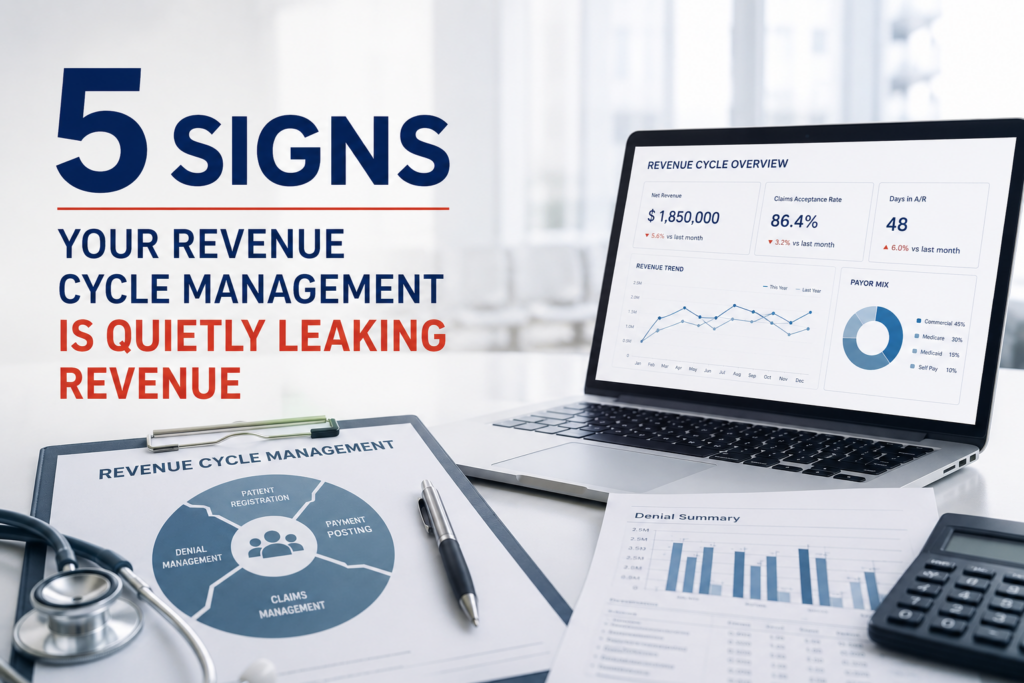
Hospitals are losing 3–5% of their net revenue annually because of missed billing opportunities, underpayments, denied claims, and inefficient revenue cycle workflows. Revenue leakage is rarely caused by one major billing mistake. Instead, it usually happens through hundreds of small, unnoticed inefficiencies across the revenue cycle. Some common signs of revenue leakage in Revenue Cycle Management include increased claim denials, accounts receivable above 120 days, tight cash flow, billing disputes, and delayed reimbursements.
Let’s explore these common signs of Revenue Cycle Management revenue leakage in detail.
One of the biggest signs of revenue leakage is a continuous increase in claim denials. Denials often happen because of inaccurate patient information, coding errors, missing documentation, or failed insurance verification. Many practices only focus on resubmitting denied claims instead of identifying the root cause, which creates repeated revenue loss over time. According to industry reports, a large percentage of denied claims are preventable, yet many healthcare organizations fail to appeal or recover them completely.
Increasing AR days is a major sign of revenue leakage in your Revenue Cycle Management. Many healthcare practices wait 90–120 days to recover payment for unpaid or denied claims, reducing the likelihood of full reimbursement. Delayed claim submissions, poor follow-up, and billing backlogs slow down cash flow and create financial pressure. Industry data also show that older claims become significantly harder to collect, resulting in silent but continuous revenue loss over time. Regular follow-ups and prompt claim handling become crucial to lowering AR days and improving reimbursement schedules. Outsource medical billing companies like Amfac MM, one of the best medical billing companies in the USA specializing in Revenue Cycle Management optimization and leakage prevention, help practices maintain professional follow-ups and reduce unnecessary delays in claim recovery.
Incorrect medical coding or incomplete clinical documentation can quietly reduce reimbursements without practices even realising it. Under-coding may lead to lower payments, while inaccurate coding can trigger audits, denials, or compliance risks. Payer policies and coding requirements continue to evolve. As payer policies and coding requirements continue to evolve, outsourcing medical coding and Revenue Cycle Management support can help healthcare practices maintain coding accuracy, improve documentation quality, and reduce recurring revenue loss caused by coding errors and compliance issues.
With rising deductibles and out-of-pocket costs, patient payments now make up a larger portion of healthcare revenue. Practices may find it difficult to collect balances on time if front desk collections, payment reminders, or patient communication procedures are inadequate. Nearly 30% of patients depart without completely understanding their financial responsibility, according to industry studies, which frequently results in unpaid accounts and delayed collections. Outsourcing Revenue Cycle Management services can help healthcare practices streamline patient communication, improve payment follow-ups, and reduce delays in patient payment collections.
Many healthcare organizations lose revenue simply because they do not have clear visibility into their financial performance. Without proper reporting and analytics, issues like underpayments, claim bottlenecks, denial trends, and billing inefficiencies remain unnoticed for months. Practices that do not regularly audit and monitor Revenue Cycle Management performance often discover revenue leakage only after it has already impacted profitability. Outsourcing Revenue Cycle Management services to an experienced and best medical billing company like Amfac MM can help healthcare providers improve financial visibility, track performance metrics more efficiently, and identify revenue leakage before it becomes a major financial burden.
The signs that your Revenue Cycle Management is leaking revenue include increased claim denials, long AR waiting periods, coding errors, documentation mistakes, and front-end errors. However, revenue leakage is usually not caused by just one issue but by multiple problems such as transaction errors, pricing mistakes in billing, administrative burden, delayed follow-ups, and weak revenue cycle processes.
Because healthcare staff are often heavily focused on clinical responsibilities, it becomes difficult for them to give dedicated attention to billing and revenue tracking. As a result, many denied claims and missed payments go unresolved. This is why many healthcare providers today prefer to outsource medical billing services to experienced revenue cycle management experts who can improve claim accuracy, reduce denials, speed up reimbursements, and recover lost revenue more efficiently. Partnering with the best medical billing company in the USA can help practices strengthen cash flow, improve operational performance, and maintain long-term financial stability.
Revenue leakage can be identified in four simple steps. First, calculate the leakage using the formula: Revenue Leakage (%) = [(Total Potential Revenue − Actual Collected Revenue) ÷ Total Potential Revenue] × 100. Second, review audits and compare CRM and billing data across different platforms to identify inconsistencies. Third, watch for warning signs such as declining profit margins, rising billing disputes, irregular cash flow, growing accounts receivable (AR), and failed transactions. Finally, automate billing processes and use revenue monitoring tools to track billing patterns and detect leakage early.
The top 6 main causes of revenue leakage are:
Revenue leakage in RCM is the unwanted loss of income caused by poor administrative management, staff inefficiencies, coding mistakes, and operational gaps. It can happen at any stage of the Revenue Cycle Management process, including the front end, middle end, or back end.
Collect visitor’s submissions and store it directly in your Elementor account, or integrate your favorite marketing & CRM tools.
Privacy Policy
Your privacy is very important to us. This Privacy Policy explains how we collect, use, and protect your information when you interact with our services, website, or communications.
Information We Collect
We may collect personal information that you provide directly to us, including but not limited to:
How We Use Your Information
We use the information we collect to:
Information Sharing
We do not sell or share your personal information with third parties for their marketing or promotional purposes.
No mobile information will be shared with third parties/affiliates for marketing/promotional purposes. All the above categories exclude text messaging originator opt-in data and consent; this information will not be shared with any third parties.
SMS Disclaimer
By providing your telephone number and submitting a form on our website or through other channels, you consent to receive SMS text messages from us.
Data Security
We use reasonable safeguards to protect your personal information from unauthorized access, disclosure, alteration, or destruction.
Updates to This Privacy Policy
We may update this Privacy Policy from time to time. Any changes will be posted on this page with an updated effective date.
Contact Us
If you have any questions about this Privacy Policy or our SMS practices, please contact us:
AmFac Medical Management
info@amfacmm.com
+1(877) 443-3655