
Liked this post? Share with others!
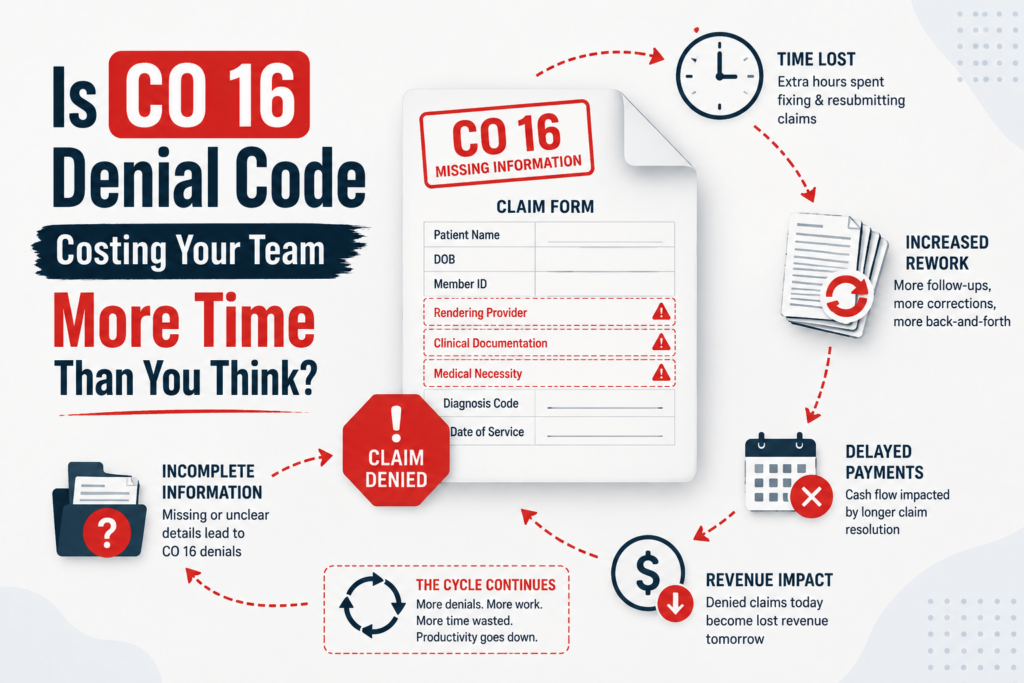
CO 16 denial code is a common claim denial code that means the claim is missing required information or contains incorrect information needed for claim processing. This can include issues such as incorrect patient details, invalid insurance information, missing modifiers, or invalid codes. According to industry estimates, nearly 20–30% of healthcare claim denials require rework and resubmission, costing providers significant time, staff effort, and delayed cash flow, ultimately leading to revenue leakage.
Nearly 65% of denied claims are never corrected or resubmitted, resulting in long-term revenue leakage for healthcare organizations. Proper interpretation of Remark Codes on the ERA/EOB helps billing teams identify the exact claim deficiency, prioritize corrective action, and improve resubmission accuracy.
Due to CO 16 denial code, healthcare teams face various challenges such as heavy rework, missed deadlines, financial errors, delayed cash flow, and other operational issues.
Let’s explore in detail the key challenges many healthcare teams face because of CO 16 denial code in medical billing.
The CO 16 Denial Code often requires billing teams to manually review claims, identify missing information, correct errors, and resubmit claims. This repetitive process consumes valuable staff time and increases workload pressure. Over time, handling denial code 16 in medical billing can also contribute to staff fatigue and reduced operational efficiency.
Every unresolved CO 16 denial can delay reimbursement for several weeks, directly impacting cash flow and revenue cycle performance. Claims stuck in ageing AR buckets increase the risk of delayed collections and revenue loss if not resolved on time. In such cases, outsourcing medical billing services from Amfac Medical Management, one of the best medical billing company USA providers, helps practices streamline AR follow-ups, reduce recurring CO 16 denials, and accelerate reimbursements.
One of the biggest challenges with the CO 16 denial code is that the denial itself is broad and does not clearly explain the exact issue. Billing teams must review additional remark codes, payer guidelines, and claim details to identify whether the problem is related to eligibility, authorization, coding, or documentation errors.
The longer it takes to investigate and correct denial code 16 in medical billing, the higher the risk of crossing the payer’s timely filing deadline. Once the filing window expires, the claim may become unrecoverable, resulting in permanent revenue loss for healthcare providers.
Since the CO 16 denial code is categorized as a contractual obligation, inaccurate payment posting or premature write-offs can create compliance and accounting issues. Proper denial management and claim review processes are essential to prevent avoidable revenue leakage.
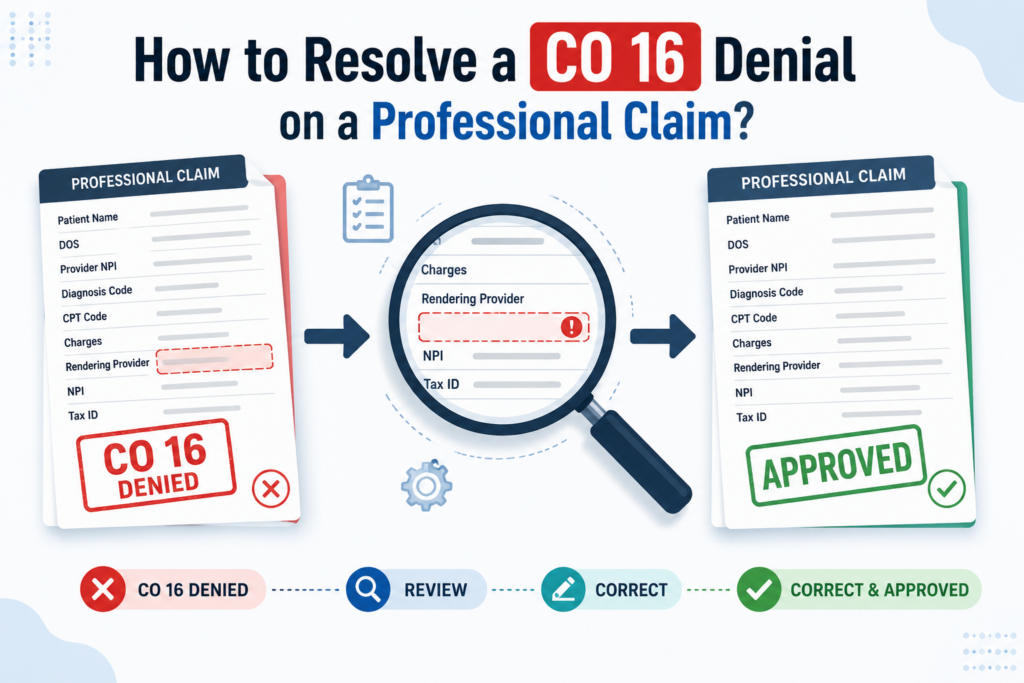
To resolve a CO-16 denial code on a professional claim, medical practices must follow CMS Claims Processing Guidance, which emphasizes accurate patient data, valid modifiers, proper diagnosis linkage, required documentation, and correct provider identifiers on the CMS-1500 claim form.
Here’s a step-by-step guide to resolve denial code 16 in medical billing
Review the EOB/ERA: Locate the RARC code accompanying the CO-16 code. This specific code (e.g., MA01, M15) will tell you exactly what is missing (e.g., a missing ZIP code or a required modifier).
Correct the Claim: Fix the data entry errors, append the required modifier, or add the missing authorization number in your billing software.
Submit as Corrected: File the corrected claim with the appropriate frequency code (often Claim Type/Code 7 for replacement). Do not simply resubmit the original claim, as this will result in a duplicate denial.
Track the Status: Monitor the claim using your Clearinghouse or payer portal (such as the Medicare Provider Enrollment, Ownership, and System (PECOS) for Medicare) to verify it is processed.
For practices managing high claim volumes, staying on top of every denial consistently can be difficult in-house. In such cases, outsourcing medical billing services from companies like AmFac MM, one of the best medical billing companies in the USA, can help by handling the entire CO 16 denial code resolution process, from EOB review to corrected claim submission, so your internal team does not have to manage everything alone.
CO 16 denial code is not just costing your team more time, but also burnout, missed timelines, and revenue loss. The best practices to prevent CO 16 denials start with cleaner submissions, proactive verification, and consistent denial tracking, all of which are difficult to maintain in-house at scale. Outsource medical billing services from a best medical billing company USA like AmFac MM ensures every denial is investigated, corrected, and resubmitted, so your practice stops losing revenue it has already earned.
Denial code 16 can be fixed after reviewing the payer’s remark codes, correcting the missing data, attaching required documentation, and resubmitting the claim promptly.
MCD denied reason code 16 means the claim was denied because required information like authorization details, incorrect patient or insurance information, coding errors, or lack of supporting documentation is missing, incomplete, or invalid for processing.
Denial Code CO 16 indicates that the claim lacks required documentation or contains missing information needed for payment processing.
Collect visitor’s submissions and store it directly in your Elementor account, or integrate your favorite marketing & CRM tools.
Privacy Policy
Your privacy is very important to us. This Privacy Policy explains how we collect, use, and protect your information when you interact with our services, website, or communications.
Information We Collect
We may collect personal information that you provide directly to us, including but not limited to:
How We Use Your Information
We use the information we collect to:
Information Sharing
We do not sell or share your personal information with third parties for their marketing or promotional purposes.
No mobile information will be shared with third parties/affiliates for marketing/promotional purposes. All the above categories exclude text messaging originator opt-in data and consent; this information will not be shared with any third parties.
SMS Disclaimer
By providing your telephone number and submitting a form on our website or through other channels, you consent to receive SMS text messages from us.
Data Security
We use reasonable safeguards to protect your personal information from unauthorized access, disclosure, alteration, or destruction.
Updates to This Privacy Policy
We may update this Privacy Policy from time to time. Any changes will be posted on this page with an updated effective date.
Contact Us
If you have any questions about this Privacy Policy or our SMS practices, please contact us:
AmFac Medical Management
info@amfacmm.com
+1(877) 443-3655