
Liked this post? Share with others!
Medical billing (conventional billing) and mental health billing may sound similar, but they are not the same. Mental health billing services differ from traditional medical billing because behavioural health claims often involve stricter documentation requirements, time-based CPT coding, prior authorizations, and payer-specific coverage limitations. These differences also contribute to higher claim denial rates. According to the Association of American Medical Colleges (AAMC), 20% of medically necessary behavioural health claims were denied, compared with 14% of general medical claims, demonstrating the additional reimbursement challenges mental health providers face.
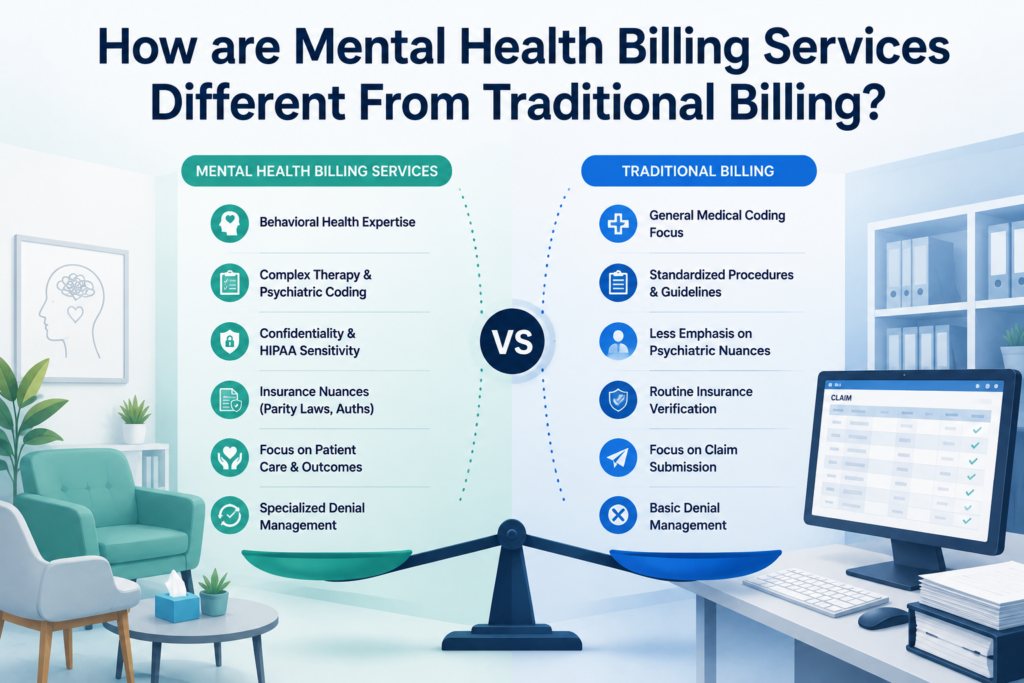
Here are the primary differences between mental health medical billing and traditional medical billing in detail:
Mental Health Billing:
This involves submitting insurance claims for behavioural health services such as psychotherapy, counselling, psychiatric evaluations, medication management, and substance use treatment. It often requires time-based CPT coding, detailed clinical documentation, prior authorizations, treatment plans, and compliance with payer-specific behavioural health policies.
Traditional Medical Billing:
This covers healthcare services such as primary care visits, specialist consultations, diagnostic tests, surgeries, and medical procedures. While it also requires accurate coding and documentation, the billing process is generally procedure-based and follows more standardized reimbursement guidelines than mental health billing.
While every healthcare speciality faces billing challenges, Mental Health Billing Services involve additional challenges that require additional knowledge and continuous monitoring. Understanding these challenges can help providers improve reimbursement rates while reducing claim denials.
One of the biggest differences between mental health billing and traditional billing is the use of time-based psychotherapy CPT codes. Codes such as 90832, 90834, and 90837 are selected based on the length of the therapy session rather than simply the procedure performed. Incorrect session times, missing documentation, or selecting the wrong CPT code can quickly result in claim denials. Therapists must carefully document session duration and ensure it matches the billed code.
Mental health claims require extensive clinical documentation to demonstrate medical necessity.
Documentation often includes:
Behavioural health claims are often reviewed more carefully because insurers evaluate medical necessity, authorization status, covered benefits, session limits, provider credentials, and coding accuracy before approving reimbursement.
Common reasons for denied mental health claims include:
Many commercial insurance plans require prior authorization before covering mental health billing services. Some plans also require authorization after a specific number of therapy visits. Failure to obtain authorization before treatment can cause denied claims, even when medically necessary services were provided. Compared to traditional medical billing, mental health medical billing providers spend considerably more time verifying benefits and obtaining approvals before treatment begins.
Insurance companies regularly update covered services, telehealth rules, reimbursement policies, documentation requirements, and coding guidelines. In addition, practices must navigate regulations such as the Mental Health Parity and Addiction Equity Act (MHPAEA), which requires mental health benefits to be comparable to medical and surgical benefits. Because payer policies can still vary from one insurance plan to another, staying compliant can be challenging and may increase the administrative burden for mental health providers.
Effective mental health billing goes beyond claim submission. It requires accurate psychotherapy coding, thorough clinical documentation, timely eligibility verification, prior authorization management, and continuous monitoring of payer-specific behavioural health policies. Partnering with an experienced mental health billing company can help behavioural health providers improve claim acceptance, reduce reimbursement delays, and maintain a more efficient revenue cycle. At AmFac Medical Management, we help psychiatrists, psychologists, therapists, counsellors, and other behavioural health providers through:
Unlike traditional medical billing, mental health billing services require specialized knowledge of psychotherapy coding, documentation, insurance policies, and compliance requirements. By following accurate billing practices and partnering with experienced professionals, providers can reduce claim denials, improve reimbursements, and streamline their revenue cycle. Contact AmFac MM, the medical billing company in the USA, for the best Medical billing services for mental health providers. Our specialized mental health billing services can help improve your practice’s revenue, reduce administrative burden, and simplify the billing process.
Choose a mental health billing service with experience in behavioural healthcare, accurate CPT and ICD-10 coding, prior authorization support, denial management, payer-specific expertise, and transparent reporting.
Mental health billing companies like AmFac MM integrate with leading practice management and EHR software to simplify scheduling, documentation, claim submission, and payment tracking.
The biggest challenges include prior authorizations, time-based psychotherapy coding, detailed documentation requirements, payer-specific policies, frequent telehealth updates, insurance eligibility verification, and claim denials due to coding or documentation errors.
The best mental health billing services for small practices provide accurate coding, insurance verification, denial management, payment posting, and ongoing revenue cycle support.
Yes. Professional mental health billing services help reduce claim denials by ensuring accurate coding, verifying patient eligibility, obtaining prior authorizations, reviewing documentation, and correcting billing errors before claims are submitted. This improves first-pass claim acceptance and supports faster reimbursements.
Collect visitor’s submissions and store it directly in your Elementor account, or integrate your favorite marketing & CRM tools.
Privacy Policy
Your privacy is very important to us. This Privacy Policy explains how we collect, use, and protect your information when you interact with our services, website, or communications.
Information We Collect
We may collect personal information that you provide directly to us, including but not limited to:
How We Use Your Information
We use the information we collect to:
Information Sharing
We do not sell or share your personal information with third parties for their marketing or promotional purposes.
No mobile information will be shared with third parties/affiliates for marketing/promotional purposes. All the above categories exclude text messaging originator opt-in data and consent; this information will not be shared with any third parties.
SMS Disclaimer
By providing your telephone number and submitting a form on our website or through other channels, you consent to receive SMS text messages from us.
Data Security
We use reasonable safeguards to protect your personal information from unauthorized access, disclosure, alteration, or destruction.
Updates to This Privacy Policy
We may update this Privacy Policy from time to time. Any changes will be posted on this page with an updated effective date.
Contact Us
If you have any questions about this Privacy Policy or our SMS practices, please contact us:
AmFac Medical Management
info@amfacmm.com
+1(877) 443-3655