
Liked this post? Share with others!
Hyperlipidemia is a condition in which a patient has abnormally high levels of lipids, such as cholesterol or triglycerides, in the blood. Because elevated lipid levels increase the risk of cardiovascular disease, stroke, and other chronic conditions, accurate diagnosis and coding are essential for both clinical management and reimbursement. The ICD 10 code for hyperlipidemia is used by healthcare providers, coders, and insurance companies to document lipid disorders consistently across the healthcare system.
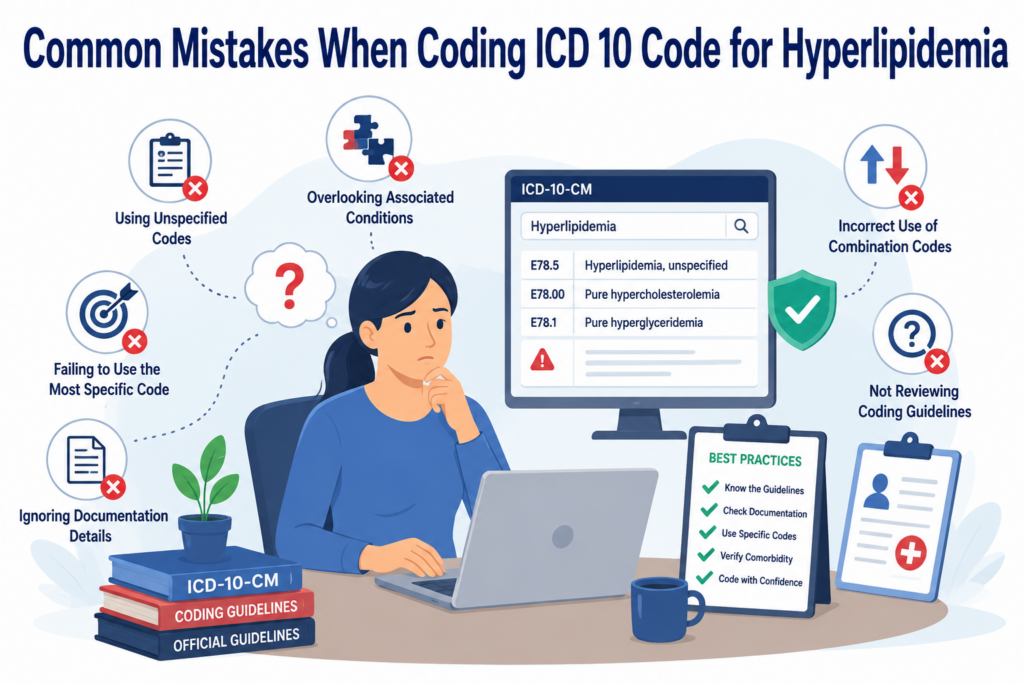
When coding the ICD-10 code for Hyperlipidemia, mistakes occur because of incomplete provider documentation, the use of general diagnosis terms instead of specific lipid disorders, incorrect use of E78.5 (Hyperlipidemia, unspecified), or assigning diagnosis codes based on laboratory results rather than the provider’s documented diagnosis.
Following the ICD-10-CM coding guidelines, maintaining accurate documentation, and conducting regular coding reviews can help minimize these errors and improve claim accuracy. Instead, this practice can outsource medical billing services from the medical billing company USA to avoid any such ICD-10 code for hyperlipidemia mistakes.
Let’s explore the common mistakes that practices make in detail,
One of the most common mistakes while coding ICD-10 codes for hyperlipidemia
is assigning E78.5 (Hyperlipidemia, unspecified) even when the provider has documented a more specific lipid disorder. According to the ICD-10-CM coding guidelines, coders should report the highest level of specificity supported by the physician’s documentation. For more accuracy and to avoid any denial claims.
To avoid this, practices should review the medical record carefully and assign codes such as E78.2 (Mixed hyperlipidemia) or E78.00 (Pure hypercholesterolemia) whenever they are specifically documented.
High cholesterol or triglyceride levels alone do not determine the diagnosis code. ICD-10-CM coding is based on the provider’s documented diagnosis and not the coder’s interpretation of laboratory values. You can avoid this problem by coding only the condition documented by the healthcare provider. If documentation is unclear, query the provider instead of assuming the diagnosis.
Although these terms are related, they are not interchangeable. Hyperlipidemia is a broader condition that includes elevated cholesterol, triglycerides, or both, while hypercholesterolemia refers specifically to elevated cholesterol. This is the most common confusion while coding the ICD-10 code for hyperlipidemia, which causes errors. To avoid this, do: match the ICD-10 code exactly to the diagnosis documented in the patient’s medical record.
During follow-up visits, providers may refine a patient’s diagnosis after reviewing additional laboratory results or clinical findings. Continuing to use an outdated diagnostic ICD-10 code for hyperlipidemia can affect coding accuracy. Thus, always review the provider’s final documentation for every encounter before assigning diagnosis codes.
The CDC/NCHS updates ICD-10-CM every fiscal year. Although lipid disorder codes do not change annually, coding guidelines, instructional notes, and related diagnosis codes may be revised over time. Always reviewing the latest ICD-10-CM code set and annual coding guideline updates before each coding year.
Avoiding coding errors for the ICD-10 code for hyperlipidemia requires more than simply selecting an ICD-10-CM code. Coders must first review the provider’s documentation to identify the specific type of hyperlipidemia, whether it is familial, pure hypercholesterolemia, mixed hyperlipidemia, or another lipid disorder. Selecting the most specific diagnosis code, verifying supporting clinical documentation, and following the latest ICD-10-CM coding guidelines help improve coding accuracy, reduce claim denials, and support appropriate reimbursement.
AmFac Medical Management supports healthcare practices by reviewing clinical documentation, identifying coding discrepancies before claims are submitted, and performing regular coding quality audits to maintain compliance with current coding standards. This proactive approach helps improve claim accuracy, reduce coding-related denials, and strengthen the overall revenue cycle while ensuring providers receive appropriate reimbursement for the care they deliver.
Understanding and applying the correct ICD-10 code for hyperlipidemia is essential for any practice that wants accurate billing, regulatory compliance, and optimal reimbursement. Common coding mistakes in ICD-10 code for hyperlipidemia, such as using unspecified diagnosis codes, relying on laboratory results instead of provider documentation, or overlooking annual coding updates, can significantly impact your practice’s revenue cycle.
However, with expert support from the medical billing company in the USA, AmFac Medical Management, healthcare providers can ensure coding accuracy, strengthen revenue cycle performance, and stay compliant in an increasingly complex billing environment.
Providers can avoid errors by maintaining complete documentation, selecting the most specific ICD-10 code, following current coding guidelines, and reviewing claims before submission.
Documentation should include the patient’s diagnosis, clinical findings, laboratory results when applicable, and the provider’s assessment and treatment plan.
No. E78.5 is used for unspecified hyperlipidemia, while other ICD-10 codes are available for specific lipid disorders, depending on the patient’s diagnosis.
Collect visitor’s submissions and store it directly in your Elementor account, or integrate your favorite marketing & CRM tools.
Privacy Policy
Your privacy is very important to us. This Privacy Policy explains how we collect, use, and protect your information when you interact with our services, website, or communications.
Information We Collect
We may collect personal information that you provide directly to us, including but not limited to:
How We Use Your Information
We use the information we collect to:
Information Sharing
We do not sell or share your personal information with third parties for their marketing or promotional purposes.
No mobile information will be shared with third parties/affiliates for marketing/promotional purposes. All the above categories exclude text messaging originator opt-in data and consent; this information will not be shared with any third parties.
SMS Disclaimer
By providing your telephone number and submitting a form on our website or through other channels, you consent to receive SMS text messages from us.
Data Security
We use reasonable safeguards to protect your personal information from unauthorized access, disclosure, alteration, or destruction.
Updates to This Privacy Policy
We may update this Privacy Policy from time to time. Any changes will be posted on this page with an updated effective date.
Contact Us
If you have any questions about this Privacy Policy or our SMS practices, please contact us:
AmFac Medical Management
info@amfacmm.com
+1(877) 443-3655