
Liked this post? Share with others!
Medical billing collections have evolved as the healthcare payment system has become more complicated. The challenge is no longer limited to sending a statement and waiting for payment. A practice may first need to verify insurance, determine patient responsibility, submit a claim, resolve payer issues, post the insurance payment correctly, and then bill the patient for the remaining balance. These complexities significantly affect practice revenue: HFMA reports that initial claim denial rates reached nearly 12% in 2024, slowing cash flow and increasing the resources and costs required to collect payment.
Earlier: Patient collections were often dominated by predictable copayments and relatively straightforward billing. Today, more patients face significant cost-sharing, while practices must manage multiple payment steps and increasingly complex administrative requirements. Research also shows that the patient side of healthcare payment remains difficult. KFF found that 41% of U.S. adults reported some form of healthcare debt in its 2022 Health Care Debt Survey, including unpaid bills, bills being paid over time, and debt taken on to pay medical or dental expenses.
That does not mean every patient’s balance will become bad debt. It does show why practices need a structured approach to patient collections rather than treating unpaid balances as an occasional administrative problem. However, the AMA specifically identifies small and rural practices as more vulnerable to financial pressures and notes that some practices rely on only one or two people for billing, coding, and insurance follow-up.
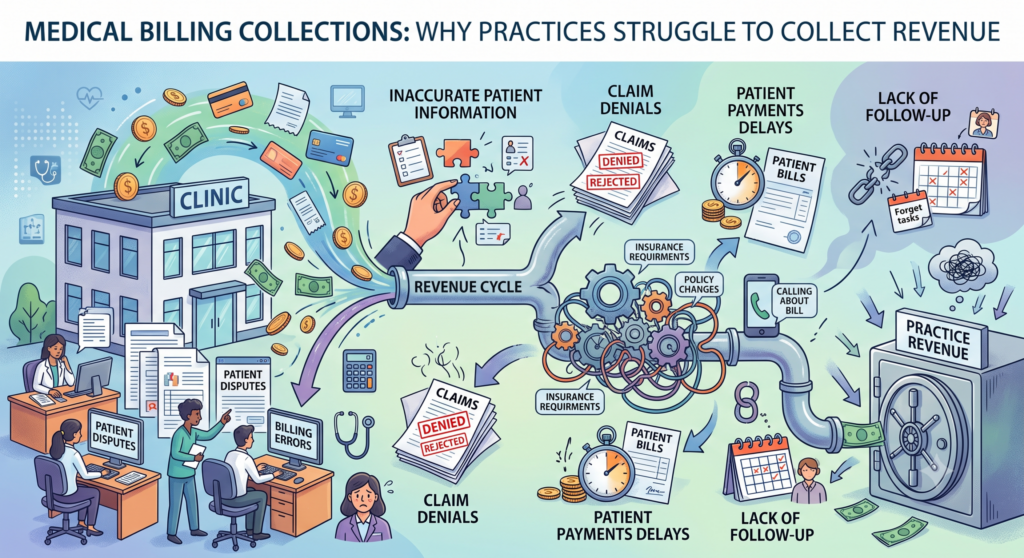
A patient’s unpaid balance does not always mean the patient is simply unwilling to pay. Several factors can make medical bill collections difficult. Let’s explore in detail why practices struggle to collect revenue.
Higher patient financial responsibility
For patients, a large unexpected balance may be difficult to afford. KFF research has found that medical debt affects insured as well as uninsured people, showing that having insurance does not necessarily eliminate financial difficulty. This can make medical billing collections more challenging for practices.
Confusing or delayed bills
Patients may receive a statement weeks after treatment and have difficulty understanding what insurance paid, what was adjusted, and what they actually owe. Thus, the AMA recommends that practices provide clear financial communication and maintain a regular process for preparing and sending patient statements.
Claim and payment problems
A claim may be rejected, denied, underpaid, or left unresolved. Until the payer portion is properly processed, the patient balance may not even be ready for collection. Recent MGMA data illustrates how broad these revenue-cycle problems can be. Its January 2026 poll identified denials and appeals as the largest reported source of revenue-cycle leakage, followed by front-end issues, billing and collections, and coding.
Aging accounts
The longer a balance remains unresolved, the more difficult it can become to collect. MGMA reported in a 2022 poll that 42% of responding medical groups waited 91–120 days before sending patient accounts to collections, while another 32% waited more than 120 days. This is why practices need defined follow-up rules instead of allowing accounts to remain untouched until they become severely aged.
Struggling with medical bill collections can cost practices additional administrative workload. The financial impact can become even greater when collection problems are caused by internal billing errors or unresolved payer issues. In that situation, staff may spend time repeatedly working the same account rather than preventing the problem from occurring again.
Not every medical billing collections problem is caused by patients or insurance companies. Internal processes can create collection difficulties too. Such as:
Poor insurance verification:
If eligibility, benefits, or patient responsibility are not verified properly, the practice may give the patient an inaccurate expectation of what they will owe.
Weak point-of-service collection:
Waiting until weeks after the appointment to collect an amount that could reasonably have been collected earlier can make the process harder.
Inconsistent statements and follow-up:
If statements are delayed or overdue accounts are not followed up according to a defined schedule, balances can age unnecessarily.
Poor communication:
Patients are more likely to question or delay payment when they do not understand why they owe a particular amount.
Lack of monitoring:
A practice cannot improve collections effectively if it does not know where money is being lost.
Leaders should monitor measures such as patient collection rates, aging AR, days in AR, statement timing, denial trends, and the percentage of patient responsibility collected at the point of service.
Outsourcing medical billing services for medical bill collection can help when a practice lacks the staff, time, or expertise to manage billing and collection workflows consistently.
A medical bill collection agency may assist with areas such as:
The AMA notes that practices may consider outside collection agencies for past-due patient balances, but recommends carefully evaluating such partners because their conduct reflects on the practice. The better approach is to identify where collections are breaking down first, then determine whether internal staff, technology, process improvements, or outsourced medical billing services are best suited to address the problem.
Medical billing collections have become more complicated as healthcare payment responsibilities have shifted and insurance and billing processes have become more complex. For practices, the challenge is not simply getting patients to pay. It is creating a collection process that starts before the claim is submitted and continues until the practice receives the money it is legitimately owed.
Strong front-end processes, accurate billing, timely follow-up, clear patient communication, and regular AR monitoring can all improve collection performance.
When internal resources are not enough, an experienced medical billing company such as AmFac Medical Management can provide additional support. But whether a practice uses an in-house team, a medical bill collection agency, or outsources medical billing services, the goal remains the same: reduce avoidable delays, make payment easier, and turn more of the revenue already generated by the practice into actual cash.
Collect visitor’s submissions and store it directly in your Elementor account, or integrate your favorite marketing & CRM tools.
Privacy Policy
Your privacy is very important to us. This Privacy Policy explains how we collect, use, and protect your information when you interact with our services, website, or communications.
Information We Collect
We may collect personal information that you provide directly to us, including but not limited to:
How We Use Your Information
We use the information we collect to:
Information Sharing
We do not sell or share your personal information with third parties for their marketing or promotional purposes.
No mobile information will be shared with third parties/affiliates for marketing/promotional purposes. All the above categories exclude text messaging originator opt-in data and consent; this information will not be shared with any third parties.
SMS Disclaimer
By providing your telephone number and submitting a form on our website or through other channels, you consent to receive SMS text messages from us.
Data Security
We use reasonable safeguards to protect your personal information from unauthorized access, disclosure, alteration, or destruction.
Updates to This Privacy Policy
We may update this Privacy Policy from time to time. Any changes will be posted on this page with an updated effective date.
Contact Us
If you have any questions about this Privacy Policy or our SMS practices, please contact us:
AmFac Medical Management
info@amfacmm.com
+1(877) 443-3655