
Liked this post? Share with others!
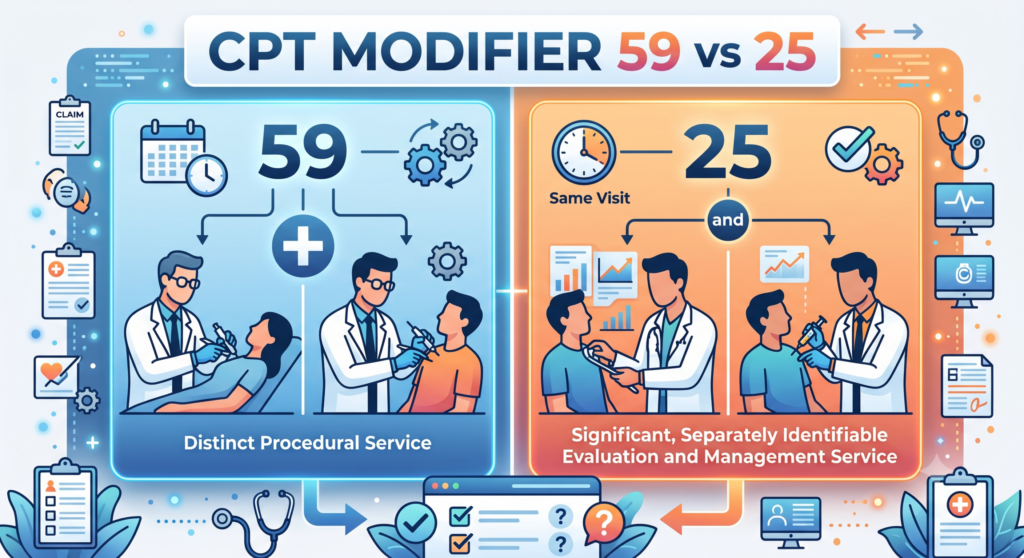
Modifier 59 and Modifier 25 are among the most frequently misused CPT modifiers because both are used to justify separate reimbursement under specific circumstances. The key difference is simple: Modifier 25 applies to a significant, separately identifiable Evaluation and Management (E/M) service, while Modifier 59 identifies a distinct procedural service. Choosing the correct modifier improves clean claim rates, reduces payer edits, and lowers audit risk.
Although both modifiers help explain why separate payment is appropriate, they serve different purposes. Understanding this distinction is critical because payers apply different reimbursement rules and National Correct Coding Initiative (NCCI) edits to each modifier.
When Should You Use Modifier 25 Instead of Modifier 59: Use Modifier 25 only when an Evaluation and Management service is significant and separately identifiable from another procedure performed on the same day.
When Should You Use Modifier 59 Instead of Modifier 25: Use the 59 modifier when documentation supports that two procedures should not be considered bundled.
Below you can find a comparison chart for CPT modifier 59 vs 25:
Comparison | Modifier 25 | Modifier 59 |
Purpose | Identifies a significant, separately identifiable E/M service | Indicates a distinct procedural service |
Used On | Evaluation & Management (E/M) codes | Procedural CPT codes |
Documentation | Separate history, exam, and medical decision-making | Documentation proving the procedure was separate and independent |
Common Denial Reason | Routine pre-operative work billed separately | Procedure not considered distinct under NCCI edits |
NCCI Relationship | Used with E/M rules | Commonly overrides appropriate NCCI procedure edits when supported |
Audit Risk | High if documentation is weak | High because modifier 59 is frequently overused |
Example | Office visit plus minor procedure | Two separate procedures performed on different anatomical sites |
This comparison helps explain the modifier 59 description and the role of Modifier 25 without relying on assumptions during claim submission.
Choosing the wrong CPT modifier 59 or any other can lead to claim denials because modifiers tell insurance payers how a service was performed and whether it qualifies for separate reimbursement. If a modifier is missing, incorrect, or unsupported by documentation, the payer may deny the claim, delay payment, reduce reimbursement, or bundle services that should have been paid separately. Accurate modifier selection helps improve first-pass claim acceptance, maintain compliance, and protect your practice’s revenue cycle.
For example, a 2025 Office of Inspector General (OIG) audit reviewing Medicare claims that used Modifier 25 found that 42% lacked sufficient documentation, placing an estimated $124 million in Medicare payments at risk of recoupment. Following these findings, the OIG added same-day Evaluation and Management (E/M) services billed with minor procedures to its active Work Plan, highlighting the growing scrutiny around modifier accuracy. This reinforces why selecting the correct modifier and maintaining complete documentation are essential for both reimbursement and compliance.
However, selecting the wrong CPT modifier can have a ripple effect across the entire revenue cycle. Beyond claim denials, incorrect modifier usage may lead to:
Choosing between Modifier 59 vs. 25 often requires more than coding knowledge—it requires a thorough understanding of payer edits, NCCI guidance, and documentation standards. AmFac Medical Management supports providers through coding reviews, claim scrubbing, denial management, payer compliance monitoring, and comprehensive medical billing services, all while following the official guidelines for Modifier 59 and Modifier 25 documentation. For practices that outsource medical billing, this structured review process helps reduce modifier-related denials, improve coding accuracy, and strengthen overall revenue cycle performance.
The most expensive modifier mistake is assuming modifier 59 and Modifier 25 are interchangeable. But they are not. Building a documentation-first coding process, reviewing NCCI edits before claim submission, and performing routine coding audits can prevent avoidable denials and support consistent reimbursement. If modifier accuracy is something your practice keeps running into trouble with, it may be worth outsourcing medical billing services that specialise in exactly this. AmFac Medical Management, one of the best medical billing companies in the USA, works with practices to build documentation-first coding workflows, verify NCCI edits before submission, and keep modifier usage audit-ready, so your team can focus on patients while claims go out right the first time.
Modifier 59 is appropriate when two non-E/M procedures performed on the same date of service are genuinely distinct and would otherwise be bundled under an NCCI Procedure-to-Procedure edit. It should only be used when no more specific X-modifier (XE, XP, XS, or XU) better describes the situation, and only when documentation clearly supports the distinction being claimed.
Specialised medical billing and RCM providers, like AmFac Medical Management, offer coding guidance on modifier 59 vs. 25 by combining certified coder review with NCCI edit verification before claims are submitted.
Incorrect use of modifier 25 or 59 leads to claim denials because payers automatically bundle unsupported claims, deny them under codes like CO-97, or flag them for audit when usage patterns look excessive.
Collect visitor’s submissions and store it directly in your Elementor account, or integrate your favorite marketing & CRM tools.
Privacy Policy
Your privacy is very important to us. This Privacy Policy explains how we collect, use, and protect your information when you interact with our services, website, or communications.
Information We Collect
We may collect personal information that you provide directly to us, including but not limited to:
How We Use Your Information
We use the information we collect to:
Information Sharing
We do not sell or share your personal information with third parties for their marketing or promotional purposes.
No mobile information will be shared with third parties/affiliates for marketing/promotional purposes. All the above categories exclude text messaging originator opt-in data and consent; this information will not be shared with any third parties.
SMS Disclaimer
By providing your telephone number and submitting a form on our website or through other channels, you consent to receive SMS text messages from us.
Data Security
We use reasonable safeguards to protect your personal information from unauthorized access, disclosure, alteration, or destruction.
Updates to This Privacy Policy
We may update this Privacy Policy from time to time. Any changes will be posted on this page with an updated effective date.
Contact Us
If you have any questions about this Privacy Policy or our SMS practices, please contact us:
AmFac Medical Management
info@amfacmm.com
+1(877) 443-3655