
Liked this post? Share with others!
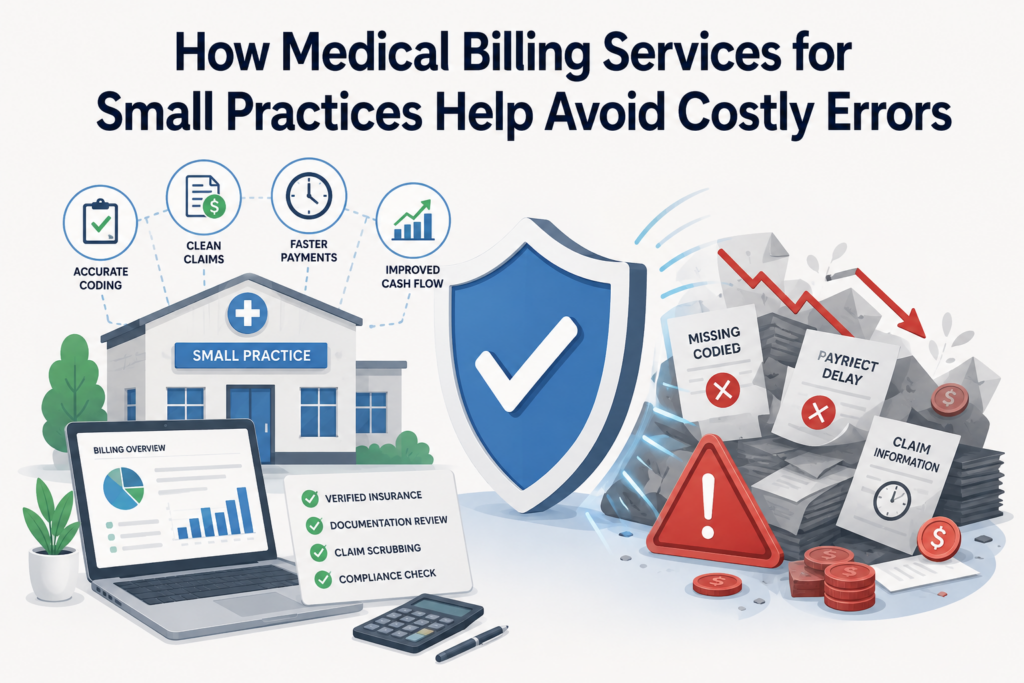
A single billing mistake can do more than delay one payment; it can trigger claim denials, increase Accounts Receivable (AR), create compliance risks, and reduce a small practice’s cash flow. For solo medical practices with limited staff, correcting these errors often costs more time and money than preventing them in the first place. In such cases, medical billing services for small practices play a key role. Outsourced medical billing services help small practices avoid costly errors by improving billing accuracy and streamlining the revenue cycle.
Small medical practices often have one team managing scheduling, insurance verification, billing, and patient communication. As patient volume grows, managing medical billing for small practices becomes more challenging and can affect the entire revenue cycle.
A few persistent billing errors account for the majority of revenue loss. Identifying and preventing them has a greater financial impact than simply increasing patient volume.
Outsource medical billing services for small practices help prevent costly errors by improving insurance verification, prior authorisation, patient registration, medical coding, clinical documentation, and claim submission accuracy. Preventing these issues reduces claim denials, protects cash flow, and strengthens the overall revenue cycle before reimbursement problems occur.
The following are a few of the most typical billing errors:
Missing Prior Authorisations
Prior authorisation problems are one of the main reasons why claims are denied, according to the Medical Group Management Association (MGMA). Medical billing specialists verify authorisation requirements before treatment, helping practices avoid preventable denials and reimbursement delays.
Incorrect Patient Demographics
MGMA also identifies patient demographic errors as a common reason claims are rejected. Incorrect names, dates of birth, insurance IDs, or coverage information can delay payment, making accurate patient registration an essential part of the billing process.
Medical Coding Errors
CMS reports that incorrect coding remains a significant contributor to improper payments for Evaluation and Management (E/M) services. Reviewing CPT, ICD-10-CM, and HCPCS codes before claim submission helps improve coding accuracy, maximise reimbursement, and strengthen medical billing for small practices.
Incomplete Clinical Documentation
One of the main reasons for payment problems, according to CMS, is inadequate documentation. Complete clinical records support accurate coding, reduce audit risks, and provide the documentation needed for successful claim processing.
Insurance Eligibility Verification Errors
Insurance coverage and benefits may change from patient visit to patient visit. Verifying eligibility before every appointment helps identify inactive coverage, authorisation requirements, and benefit limitations before claims are submitted.
Duplicate or Inaccurate Claim Submission
Duplicate claims and incorrect claim details often result in unnecessary payment delays and additional administrative work. Before submission, these problems are found through quality checks and claim scrubbing.
Poor Denial Management
Simply resubmitting denied claims rarely solves the underlying problem. A strong denial management process identifies why claims are denied, fixes underlying workflow issues, and reduces repeat billing mistakes.
By increasing coding accuracy, confirming insurance eligibility, managing previous authorisations, submitting clean claims, and proactively resolving denials before they affect reimbursement, medical billing for small practices helps avoid expensive billing problems. These structured revenue cycle processes reduce administrative burden while improving cash flow and billing performance.
At AmFac Medical Management, we support small healthcare practices with integrated Revenue Cycle Management solutions designed to strengthen billing accuracy, improve operational efficiency, and reduce preventable revenue loss. Here’s how our team helps practices build a stronger and more reliable revenue cycle:
Review Documentation Before Claims Are Submitted
AmFac MM’s experienced billing specialists review clinical documentation before coding begins. Instead of waiting for payer denials, this aids in the early detection of missing information. The result is a higher percentage of clean claims submitted on the first attempt. Additionally, our coding specialists follow the latest CMS guidelines and established coding standards from AHIMA and AAPC to ensure accurate coding, minimise avoidable claim denials, and improve revenue cycle performance.
Monitor Billing Performance With KPIs
One advantage of medical billing services for small practices is ongoing performance monitoring. Through constant observation of key performance indicators (KPIs), such as:
Our team helps practices identify workflow gaps early, measure billing performance, and resolve operational issues before they affect reimbursement or cash flow.
Standardise Front-End Processes
Based on our experience working with healthcare practices, many revenue cycle challenges start well before a claim reaches the submission stage. To prevent them, AmFac MM’s specialists:
Accurate front-end processes help reduce preventable downstream billing issues and improve overall revenue cycle performance.
Improve Communication Between Clinical and Billing Teams
Billing works best when providers and billers communicate consistently. For instance, when specific procedures repeatedly create confusion for coders, documentation templates can be updated to address these issues and prevent future delays. This collaborative process helps minimise recurring documentation gaps, improve coding accuracy, and speed up claim processing over time.
Choosing the best medical billing company USA means selecting a partner that helps prevent billing errors, not just fix them after they occur.
Medical billing services for small practices are more important than ever due to the increasing complexities of the healthcare industry. However, it can be difficult for small practices to manage these challenges on their own because of staff shortages, limited expertise, and time constraints. This is where medical billing services help small practices prevent costly mistakes by improving workflow accuracy, reducing claim denials, and strengthening the overall revenue cycle. Investing in dependable billing support allows practices to safeguard revenue while providing better patient care as payer requirements continue to change.
They improve insurance verification, coding accuracy, documentation review, and claim submission processes, reducing preventable errors before claims reach the payer.
Small practices typically have fewer administrative resources, so correcting denied claims takes valuable staff time and delays reimbursements that directly affect cash flow.
That’s when claim denials are rising, Accounts Receivable is growing, billing backlogs are occurring, staff shortages are happening or when it’s hard to keep up with payer requirements.
Collect visitor’s submissions and store it directly in your Elementor account, or integrate your favorite marketing & CRM tools.
Privacy Policy
Your privacy is very important to us. This Privacy Policy explains how we collect, use, and protect your information when you interact with our services, website, or communications.
Information We Collect
We may collect personal information that you provide directly to us, including but not limited to:
How We Use Your Information
We use the information we collect to:
Information Sharing
We do not sell or share your personal information with third parties for their marketing or promotional purposes.
No mobile information will be shared with third parties/affiliates for marketing/promotional purposes. All the above categories exclude text messaging originator opt-in data and consent; this information will not be shared with any third parties.
SMS Disclaimer
By providing your telephone number and submitting a form on our website or through other channels, you consent to receive SMS text messages from us.
Data Security
We use reasonable safeguards to protect your personal information from unauthorized access, disclosure, alteration, or destruction.
Updates to This Privacy Policy
We may update this Privacy Policy from time to time. Any changes will be posted on this page with an updated effective date.
Contact Us
If you have any questions about this Privacy Policy or our SMS practices, please contact us:
AmFac Medical Management
info@amfacmm.com
+1(877) 443-3655