
Liked this post? Share with others!
Healthcare organisations generate thousands of documents every year, including patient records, insurance forms, referrals, prior authorisations, physician notes, laboratory reports, and billing documents. According to HIMSS, hospitals generate millions of clinical documents annually, making document management one of the largest administrative challenges in healthcare. This is where document management services become a game changer.
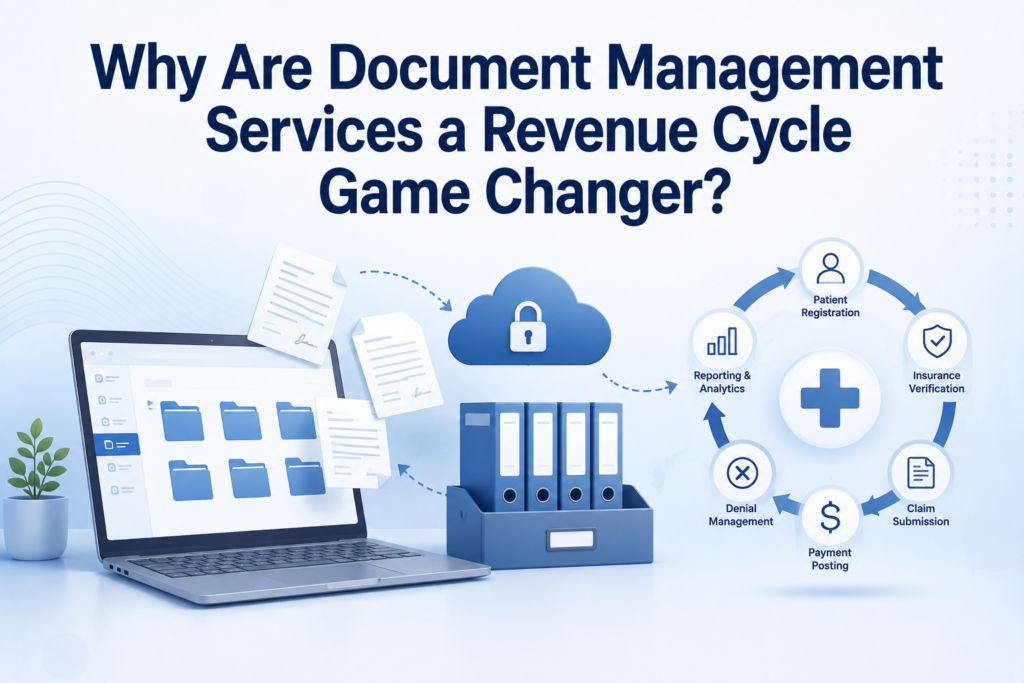
Document management services help healthcare providers securely capture, organise, store, retrieve, and manage clinical and administrative documents throughout the patient care journey. Instead of relying on paper files or scattered digital folders, practices can implement centralised document management solutions that improve accessibility, reduce administrative workload, and support a healthier revenue cycle.
Document management services are systems and processes that securely manage healthcare documents throughout the patient journey. They cover everything from scanning paper records and organising digital files to securely storing, indexing, and retrieving documents whenever they are needed.
Common documents managed include:
When documentation is organised and readily available, clinical staff, coders, and billing teams spend less time searching for information and more time moving claims through the reimbursement process.
Every claim submitted to an insurance payer must be supported by complete clinical documentation. Even a small documentation gap can interrupt the billing process. Thus, document management services are important for a healthy RCM.
The following are some of the key challenges healthcare organisations experience due to bad document management.
Delayed Claim Submission
Claims often remain on hold because physicians have not completed their documentation or billing teams cannot locate the required records. Missing referrals, prior authorisations, or treatment notes can delay submission and extend reimbursement timelines.
With centralised document management, practices can quickly retrieve supporting documents, making clean claim submission faster and easier.
Coding Errors Caused by Incomplete Records
Medical coders rely on physician documentation to assign accurate ICD-10, CPT, and HCPCS codes. If operative reports, progress notes, or diagnostic results are incomplete, coding accuracy suffers.
For example, a procedure note missing key clinical details may require multiple clarification requests before coding can be completed. These delays increase administrative work and may ultimately affect reimbursement. Well-organised documentation allows coding teams to work more efficiently while reducing preventable billing errors.
Documentation-Related Claim Denials
Many denied claims have one thing in common: insufficient documentation. Missing physician signatures, incomplete treatment records, or unavailable supporting documents frequently trigger payer requests for additional information or outright claim denials. Strong document management services help practices maintain complete patient records, improving first-pass claim acceptance and reducing avoidable rework.
Compliance and Audit Risks
Healthcare organisations must maintain secure and accurate documentation to meet HIPAA and payer requirements. During an audit, retrieving patient records should take minutes, not hours. A digital document management system improves security, maintains an organised audit trail, and allows authorised personnel to quickly find documents required during compliance reviews.
A strong revenue cycle depends on accurate documentation from the patient’s first appointment through final payment. When every document is organised and accessible, each department works more efficiently.
For example, a billing specialist preparing a claim after a patient undergoes a surgical procedure. Instead of searching through paper charts or requesting missing files from multiple departments, every required document, including physician notes, operative reports, referrals, and insurance authorisations, is available in one secure location.
This streamlined workflow shortens claim preparation time, reduces administrative delays, and allows reimbursements to reach the practice sooner.
Unlike paper-based systems, modern document management solutions support faster collaboration between providers, coders, and billing teams, creating a smoother reimbursement process from start to finish.
Managing thousands of patient records internally can become challenging as a practice grows. If staff spend valuable time searching for documents, responding to payer requests, or managing paper records, it may be time to consider professional document management solutions.
Healthcare organisations often benefit from outsourcing when they experience:
Practices that outsource medical billing often choose to outsource document management as well. When documentation and billing workflows work together, claims move through the revenue cycle more efficiently, reducing delays and improving overall financial performance.
The level of service you receive depends on the provider you choose. Before selecting any document management services, healthcare organisations should evaluate whether the company provides:
At the best medical billing company USA, AmFac Medical Management, we help healthcare providers securely digitise, organise, and manage patient records while supporting efficient billing workflows. Our team converts paper files into searchable digital records, making documentation easier to access, improving operational efficiency, and helping practices maintain a healthier revenue cycle.
Efficient documentation is one of the most overlooked drivers of revenue cycle performance. When patient records are complete, organised, and readily available, providers can reduce coding delays, minimise claim denials, improve compliance, and accelerate reimbursements. Whether you manage documentation internally or partner with a trusted provider, investing in reliable document management services strengthens both operational efficiency and financial performance. For practices looking to simplify workflows and improve reimbursement outcomes, combining professional document management with expert medical billing services can deliver long-term value.
Document management services keep patient records organised and easily accessible, allowing billing teams to submit claims faster, improve coding accuracy, reduce documentation-related denials, and accelerate insurance reimbursements.
Yes. Many claim denials occur because of missing physician notes, incomplete documentation, or unavailable supporting records. Organised documentation helps billing teams submit cleaner claims with the required clinical evidence.
An EHR stores patient health information, while document management solutions organise, index, retrieve, and securely manage both clinical and administrative documents across the healthcare workflow. Many organisations use both systems together.
Collect visitor’s submissions and store it directly in your Elementor account, or integrate your favorite marketing & CRM tools.
Privacy Policy
Your privacy is very important to us. This Privacy Policy explains how we collect, use, and protect your information when you interact with our services, website, or communications.
Information We Collect
We may collect personal information that you provide directly to us, including but not limited to:
How We Use Your Information
We use the information we collect to:
Information Sharing
We do not sell or share your personal information with third parties for their marketing or promotional purposes.
No mobile information will be shared with third parties/affiliates for marketing/promotional purposes. All the above categories exclude text messaging originator opt-in data and consent; this information will not be shared with any third parties.
SMS Disclaimer
By providing your telephone number and submitting a form on our website or through other channels, you consent to receive SMS text messages from us.
Data Security
We use reasonable safeguards to protect your personal information from unauthorized access, disclosure, alteration, or destruction.
Updates to This Privacy Policy
We may update this Privacy Policy from time to time. Any changes will be posted on this page with an updated effective date.
Contact Us
If you have any questions about this Privacy Policy or our SMS practices, please contact us:
AmFac Medical Management
info@amfacmm.com
+1(877) 443-3655