
Liked this post? Share with others!
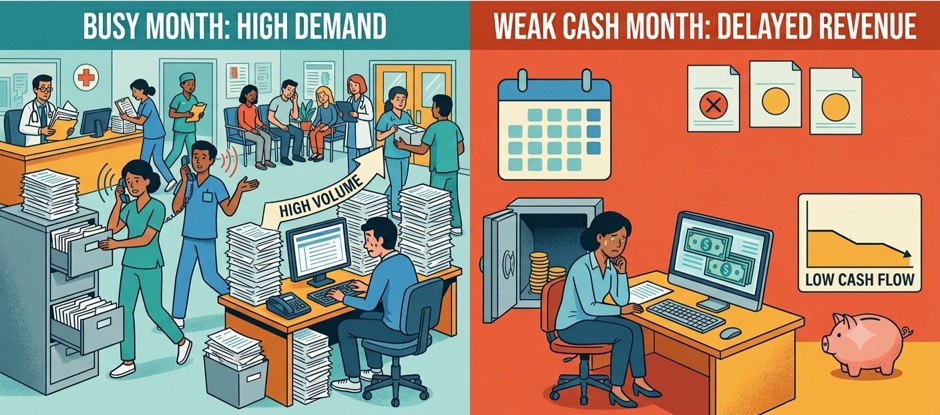
Picture a month where the schedule was packed, the waiting room was full, and the claims flew out the door. Then you check the bank balance, and it’s underwhelming. Nothing is broken. Delivering care and getting paid are two different stages, and they happen weeks apart.
Patient visits go in one end. Cash comes out the other end, only after documentation, coding, claim submission, payer processing, corrections and payment posting. If any stage slows down, a busy month can produce more work without more cash. Here is a typical journey (your own timing will vary by payer and speciality).
That’s why a busy August may show up as a strong September or October, not August.
Imagine a restaurant with every table taken all night. Orders go out, and the staff never stops. Yet at closing, the register is lighter than expected. Some diners haven’t paid yet, some payments are processing, and a few orders were rung up wrong and need fixing. The place was busy, but busy isn’t the same as paid.
A practice works the same way. Visits are production. Claims are payment requests. Payments are cash. They’re linked, but they don’t happen at the same time.
Larger organizations often have separate teams for billing, denials and posting. Solo doctors and small groups tend to lean on one or two people, or an outside billing partner, so delays are harder to see. You might notice a full calendar but late claim submission, more volume but a growing documentation backlog, or higher charges but lower-than-expected collections.
For an owner, the sharper question isn’t only “how many patients did we see?” It’s “how quickly did those visits turn into collectable revenue?”
Instead of judging a month by visits or charges alone, follow the work through the pipeline:
This tells you whether the slowdown is low volume, slow billing, payer delay or weak follow-up. Those problems have very different fixes.
Say a solo physician adds 20% more visits in a month, but notes stay unfinished and claims go out late. The result is more encounters, more waiting charges, more claims needing correction, more money sitting in accounts receivable, and not much more cash. Volume went up while cash conversion slid.
Reading the month well means comparing activity with cash. A month can bring high volume with low collections, or lower volume with strong cash because older claims finally paid, or steady revenue with growing receivables. Each tells a different story.
Busy doesn’t automatically mean financially strong, and quiet doesn’t automatically mean weak. What matters is how smoothly the work you’ve already done turns into accurate, timely, collectable revenue. A clear timeline also helps an RCM (revenue cycle management) partner like AmFac see where cash is slowing down, without taking financial visibility away from the practice owner.
Shorten the time between care and payment. Focus on clean claims, faster charge submission, proactive denial follow-up, eligibility checks, timely patient statements and steady A/R (accounts receivable) follow-up. Track days in A/R, ageing buckets, denial rate and collection rate to see where cash is getting stuck.
Make it easy to understand and pay. Give cost estimates when possible, collect copays and known balances at or before the visit, send clear statements quickly, and offer online payment, text-to-pay and payment plans. Consistent follow-up on open balances helps too.
Collect visitor’s submissions and store it directly in your Elementor account, or integrate your favorite marketing & CRM tools.
Privacy Policy
Your privacy is very important to us. This Privacy Policy explains how we collect, use, and protect your information when you interact with our services, website, or communications.
Information We Collect
We may collect personal information that you provide directly to us, including but not limited to:
How We Use Your Information
We use the information we collect to:
Information Sharing
We do not sell or share your personal information with third parties for their marketing or promotional purposes.
No mobile information will be shared with third parties/affiliates for marketing/promotional purposes. All the above categories exclude text messaging originator opt-in data and consent; this information will not be shared with any third parties.
SMS Disclaimer
By providing your telephone number and submitting a form on our website or through other channels, you consent to receive SMS text messages from us.
Data Security
We use reasonable safeguards to protect your personal information from unauthorized access, disclosure, alteration, or destruction.
Updates to This Privacy Policy
We may update this Privacy Policy from time to time. Any changes will be posted on this page with an updated effective date.
Contact Us
If you have any questions about this Privacy Policy or our SMS practices, please contact us:
AmFac Medical Management
info@amfacmm.com
+1(877) 443-3655