Liked this post? Share with others!
Dental billing is different because dental practices handle many different procedures, and each may have specific coding and documentation requirements. The American Dental Association maintains the CDT Code set specifically for reporting dental procedures and updates it regularly. This means billing teams need to work with current coding information rather than relying on outdated code references.
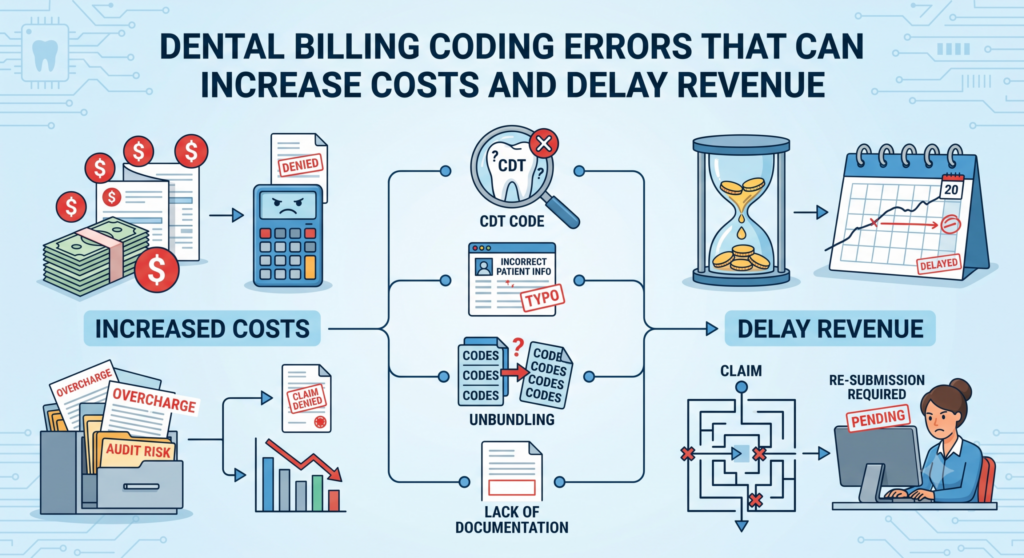
Errors can also occur when the procedure code does not match the clinical documentation or when required details such as tooth number, surface, or supporting information are missing. For example, if the clinical record supports one procedure but the claim reports another, the payer may question whether the service was correctly billed. The problem for practice is not only a possible denial. Staff may have to review the chart, identify the error, correct the claim, resubmit it, and follow up again. Repeated corrections increase workload while delaying payment.
Wrong coding and modifiers, bundling errors, and missing important information are some of the common coding errors in dental billing that can affect a practice’s revenue and lead to significant rework.
Let’s explore these problems in detail and how they affect dental practices:
Selecting a code that does not accurately describe the procedure performed can cause claim processing problems. This can happen when similar procedures have different coding requirements or when outdated coding information is used. Such wrong code can turn a completed procedure into a claim that requires correction, delaying reimbursement and creating additional billing work.
Many dental procedures require specific teeth and, where applicable, surface information. Entering incomplete or incorrect details can make the claim inconsistent with the procedure being reported, resulting in avoidable rework or payer questions.
The patient’s clinical record should support the service reported on the claim. If the documentation does not adequately support the procedure, the dental billing team may have difficulty defending the claim if the payer requests additional information. This can affect the practice because weak documentation can make it harder to resolve denials and may increase the time required to research individual claims.
Depending on the procedure and payer requirements, modifiers and other claim information may affect how a service is processed. Repeated claim corrections consume staff capacity that could otherwise be used for current claims, patient accounts, and AR follow-up.
Some services should be reported together under a specific coding rule, while others may be separately reportable when requirements are met. Errors in bundling can result in payment differences, denials, or additional review, particularly when they occur repeatedly.
The financial effect of coding errors in dental billing depends on claim volume, procedure mix, payer contracts, reimbursement amounts, and how quickly problems are corrected. Therefore, practices should calculate their own impact instead of relying on a generic “average cost.”
To understand more clearly how it is affecting your practice financially, here’s an illustrative example: Suppose a dental practice submits 1,000 claims per month and 3% require correction because of coding-related issues. That means approximately 30 claims need additional attention. Thus, if each claim requires 15 minutes of staff time to research, correct, and resubmit, that creates about 7.5 hours of additional administrative work every month. And staff time is only one part of the cost.
The American Dental Association notes that common coding errors can lead to claim denials and delayed payments, and recommends reviewing procedure codes before claims are submitted to help prevent these issues.
If some of those claims are high-value procedures, the amount of revenue temporarily tied up can be much larger than the administrative cost of correcting them. A coding error becomes expensive when it is repeated. The goal should not simply be to fix individual claims but to identify why the same errors keep occurring.
To prevent recurring coding errors, dental practices first need to identify where and why they occur. Dental practices can look for patterns instead of reviewing every denial as a separate event. Practices can identify recurring problems by looking for patterns in the following areas:
Prevention requires consistent coding workflows, current coding references, accurate documentation, and regular audits.
Let’s explore how to prevent errors in detail:
Keep coding references current: CDT codes and coding guidance change, so billing teams should use current resources and stay informed about annual updates.
Perform regular coding audits: Reviewing a sample of claims can reveal recurring errors before they spread across a larger volume of claims.
Strengthen documentation workflows: Clinical and billing teams should understand what information is needed to support the procedures being reported.
Track Denial Trends: Do not only correct denied claims. Identify the root cause and determine whether training, documentation, or workflow changes can prevent the problem.
Use specialized dental billing support when necessary. If internal staff are consistently overloaded with claim corrections, denial follow-up, or AR management, professional dental billing services may provide additional expertise and process support.
Practices considering outsourcing dental billing services should compare their current denial, correction, and collection costs with the expected value of specialized support. If recurring coding problems are consuming significant staff time or delaying collections, this comparison can help determine whether external support is financially justified.
Dental coding errors rarely remain “small” when they occur repeatedly. A wrong CDT code, incomplete claim detail, documentation mismatch, or incorrect coding practice can create rework, payment delays, and additional AR. Tracking these errors by frequency and financial impact allows dental practices to identify the problems that matter most and fix them at the source. Accurate dental billing and coding is therefore not only about clean claims; it is also an important part of protecting practice revenue and staff productivity.
Common mistakes include incorrect CDT codes, missing modifiers, inaccurate tooth numbers or surfaces, incomplete documentation, and coding services that are not supported by the patient’s records.
Consistent coding inaccuracies can lead to claim denials, delayed payments, increased rework, higher administrative costs, and lost revenue for dental practices.
Collect visitor’s submissions and store it directly in your Elementor account, or integrate your favorite marketing & CRM tools.
Privacy Policy
Your privacy is very important to us. This Privacy Policy explains how we collect, use, and protect your information when you interact with our services, website, or communications.
Information We Collect
We may collect personal information that you provide directly to us, including but not limited to:
How We Use Your Information
We use the information we collect to:
Information Sharing
We do not sell or share your personal information with third parties for their marketing or promotional purposes.
No mobile information will be shared with third parties/affiliates for marketing/promotional purposes. All the above categories exclude text messaging originator opt-in data and consent; this information will not be shared with any third parties.
SMS Disclaimer
By providing your telephone number and submitting a form on our website or through other channels, you consent to receive SMS text messages from us.
Data Security
We use reasonable safeguards to protect your personal information from unauthorized access, disclosure, alteration, or destruction.
Updates to This Privacy Policy
We may update this Privacy Policy from time to time. Any changes will be posted on this page with an updated effective date.
Contact Us
If you have any questions about this Privacy Policy or our SMS practices, please contact us:
AmFac Medical Management
info@amfacmm.com
+1(877) 443-3655