
Liked this post? Share with others!
Somewhere in your practice, someone has said, “That claim didn’t get paid.” It’s true, and it tells you almost nothing.
Did the payer never see the claim? Did it read the claim and say no? Is it still sitting in a queue? Or did it pay, just not enough? Each answer points to a different fix, a different deadline, and sometimes a different person who needs to act.
Here’s how to tell them apart.
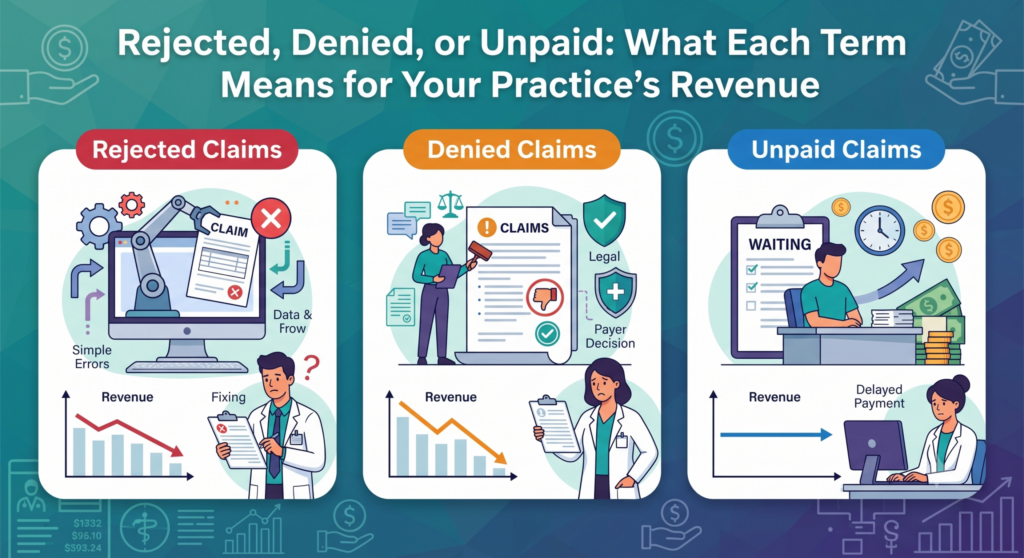
A rejection means the clearinghouse or payer refused to accept the claim for processing. It’s a gatekeeping problem, not a judgment about your care. Usually something is missing, invalid, or formatted wrong: a mistyped member ID, a bad payer ID, an incorrect NPI, an invalid code, a duplicate submission caught at intake.
Because the claim never reached adjudication, the fix is mechanical. Correct the error, resubmit, and confirm it was accepted this time.
Speed matters here. A rejected claim usually isn’t treated as filed, so the filing-deadline clock keeps running while it sits in a rejection queue. And since the payer never adjudicated it, there’s nothing to appeal. You fix it and send it again.
Example: A claim goes out with one wrong digit in the member ID. The clearinghouse bounces it the same day. Verify the insurance details, fix the ID, resubmit.
The trap is thinking a resubmitted claim is a resolved claim. It isn’t until the payer accepts and adjudicates it.
A denial means the payer processed the claim and decided not to pay all or part of it. Common reasons include medical necessity, missing authorization, a noncovered service, a coding mismatch, a bundled service, an eligibility gap on the date of service, or a missed filing deadline.
You can often recover a denied claim, but the right move depends on the reason. A denial for missing authorization calls for a different response than one for medical necessity. The first may need proof that authorization existed. The second may need a clinician’s records and reasoning.
Two numbers matter here, and they aren’t the denial count. One is the dollar value tied to denials. A low denial rate can hide serious losses if the denied claims are the expensive ones. The other is the deadline: appeal windows close, and a denial treated as “pending” quietly expires.
“Unpaid” just means money hasn’t arrived. It doesn’t say why. The claim could be pending, rejected and never corrected, denied and waiting on an appeal, partially paid, held for missing information, stuck in coordination of benefits, or simply sitting in the patient’s column.
Example: A claim went out 45 days ago, and nothing has come back. It could be lost in routing, rejected without anyone noticing, or delayed on the payer’s end. The only way to know is to check. Don’t assume it’s a denial.
This is the quiet one. The payer paid, the claim closed, and nobody looked twice, yet the amount doesn’t match what your contract says you should receive. Causes include a wrong fee schedule, modifier errors, a missed multiple-procedure reduction, place-of-service errors, or a miscalculation in coordination of benefits.
Underpayments never trigger a denial notice, so they only surface if someone compares payments against expected allowed amounts.
Visit → claim created → submitted → accepted or rejected → adjudicated → paid, denied, or partially paid → balance resolved.
Term | Where it happens | What it calls for |
Rejected | Before adjudication | Correct and resubmit |
Denied | After adjudication | Read the reason, then correct, appeal, or accept |
Unpaid | Anywhere | Find out the current status |
Underpaid | After payment | Compare against the contract and investigate |
Treat a rejection like a denial, and someone spends an afternoon writing an appeal for a claim that only needed a corrected ID. Treat a denial like a pending claim, and the appeal deadline passes. Lump everything into “outstanding”, and you lose sight of where the money is actually stuck.
Physicians come in at specific points: clarifying documentation, confirming a service was performed, answering a coding query, or supporting a medical-necessity appeal. Billing can run the process, but it can’t invent clinical facts that were never documented.
Instead of one “outstanding” number, split accounts by status: rejected and awaiting correction, denied and awaiting appeal, pending with the payer, underpaid, patient balances, and anything approaching a filing or appeal deadline. That one change turns a vague worry into a to-do list.
If you’d like help sorting your open claims into these categories, AmFac Medical Management can walk through it with you.
A rejected claim was never accepted for processing, usually because of a data or formatting error, so it’s corrected and resubmitted. A denied claim was processed, and the payer declined to pay it as billed, so the denial reason decides whether to correct, appeal, or accept it.
It means no payment has been received, but it doesn’t say why. The claim may be pending, rejected, denied, partially paid, or waiting on the patient, so the account’s actual status has to be checked.
Rejections usually come from wrong patient or payer information, invalid NPI or codes, missing data, formatting errors, or duplicates. Denials usually come from medical necessity, missing authorization, noncovered services, coding mismatches, eligibility problems, missed filing deadlines, or documentation that doesn’t support the service billed.
Collect visitor’s submissions and store it directly in your Elementor account, or integrate your favorite marketing & CRM tools.
Privacy Policy
Your privacy is very important to us. This Privacy Policy explains how we collect, use, and protect your information when you interact with our services, website, or communications.
Information We Collect
We may collect personal information that you provide directly to us, including but not limited to:
How We Use Your Information
We use the information we collect to:
Information Sharing
We do not sell or share your personal information with third parties for their marketing or promotional purposes.
No mobile information will be shared with third parties/affiliates for marketing/promotional purposes. All the above categories exclude text messaging originator opt-in data and consent; this information will not be shared with any third parties.
SMS Disclaimer
By providing your telephone number and submitting a form on our website or through other channels, you consent to receive SMS text messages from us.
Data Security
We use reasonable safeguards to protect your personal information from unauthorized access, disclosure, alteration, or destruction.
Updates to This Privacy Policy
We may update this Privacy Policy from time to time. Any changes will be posted on this page with an updated effective date.
Contact Us
If you have any questions about this Privacy Policy or our SMS practices, please contact us:
AmFac Medical Management
info@amfacmm.com
+1(877) 443-3655