
Liked this post? Share with others!
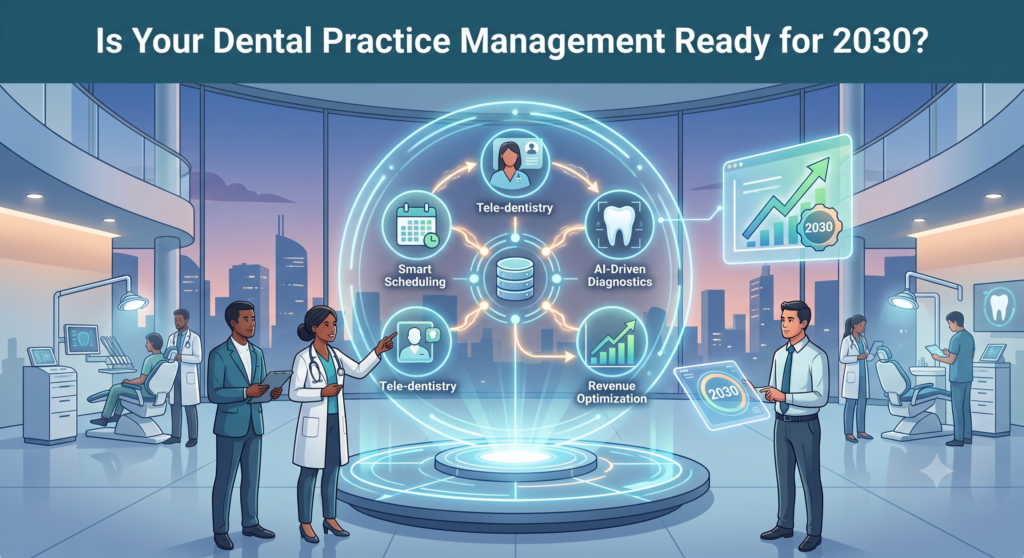
By 2030, dental practice management will extend far beyond scheduling appointments and processing insurance claims. Practices will increasingly rely on AI-powered administrative tools, cloud-based practice management software, automated eligibility verification, predictive revenue analytics, digital patient communication, and real-time financial dashboards.
Future-ready dental practices are expected to:
Practices that adopt these technologies early are more likely to improve operational efficiency, reduce administrative costs, and deliver a smoother patient experience.
Running a successful dental practice will require more than scheduling appointments and treating patients. Administrative efficiency, navigating complex insurance requirements, addressing staffing shortages, managing documentation, and ensuring faster claims processing will all become critical dental practice management challenges. Successfully managing these areas will be essential for maintaining an efficient and financially healthy dental practice.
These concerns are already affecting practices today. According to the American Dental Association (ADA) Health Policy Institute, 55.3% of dentists identified insurance-related issues, including claim denials, delayed payments, and low reimbursements, as one of their biggest challenges, while 54.2% cited staffing shortages. These trends highlight why efficient dental practice management is becoming increasingly important.
A small mistake in patient registration or insurance verification can disrupt the entire revenue cycle by delaying claims and payments. For example, an outdated insurance record may lead to a denied claim. The billing team must then investigate the issue, correct the information, resubmit the claim, and wait for reimbursement again. This consumes valuable staff time and delays cash flow.
Strong dental practice management focuses on preventing these problems before they occur rather than fixing them later. Another growing concern is dental RCM. Revenue cycle management begins before a patient arrives and continues until the final payment is collected. Weak workflows at any stage- eligibility verification, coding, claim submission, payment posting, or denial follow-up- can reduce practice revenue.
Practices using reliable dental practice solutions often improve communication between front-office staff, providers, and billing specialists, helping reduce preventable claim errors.
Successful dental practices monitor operational and financial performance using measurable indicators rather than assumptions. Important metrics include:
Tracking these KPIs regularly helps identify workflow issues before they impact profitability.
Modern dental practice management software does much more than organise appointments. It acts as the operational hub of a dental practice by connecting clinical care, billing, scheduling, patient communication, reporting, and revenue management into one centralised system.
For example, automated insurance verification before appointments reduces eligibility errors, digital treatment plans improve patient acceptance, integrated billing minimises duplicate data entry, and real-time dashboards allow practice owners to monitor collections, outstanding claims, and financial performance without relying on manual reports.
Research has shown that digital patient management systems can significantly improve operational efficiency. In one study, appointment scheduling time decreased by nearly 67%, billing errors dropped by over 70%, and 88% of dental professionals reported lower administrative workload after implementing digital management software.
While software improves efficiency, technology alone cannot maximise collections. Strong documentation, accurate coding, proactive denial management, and continuous dental RCM oversight remain essential components of successful practice management.
Outsourcing is no longer limited to large healthcare organisations. Independent providers and growing dental practices are increasingly partnering with specialised billing companies to improve efficiency.
Professional medical billing services can manage many time-consuming administrative tasks, including:
This allows dentists and office staff to spend more time focusing on patient care. For practices looking to strengthen dental RCM, outsourcing dental RCM services can also provide access to experienced billing professionals who stay updated with payer policies and coding changes.
Choosing the right partner is important. The best medical billing company USA providers typically offer transparent reporting, compliance-focused workflows, experienced coding teams, and proactive revenue monitoring rather than simply submitting claims.
Which is why AmFac Medical Management is also known as the best medical billing company USA, as we help healthcare organisations strengthen both operational efficiency and revenue performance through integrated practice management support and through our DentOffice software. We support dental practices with practice management software solutions and workflow optimisation, and combining technology with experienced billing professionals, practices can simplify administrative processes, improve financial visibility, and create a more efficient patient care experience.
Dental Practice Management in 2030 will be defined by operational efficiency as much as clinical excellence. Practices that embrace automation, strengthen dental RCM, monitor performance through measurable KPIs, and invest in integrated dental practice solutions will be better positioned to navigate evolving reimbursement models and rising administrative demands. Whether managing billing internally or choosing to outsource medical billing, the goal remains the same: creating a streamlined practice that delivers excellent patient care while maintaining healthy financial performance. Working with an experienced partner such as AmFac Medical Management can help practices modernise workflows, improve collections, and prepare confidently for the future of dentistry.
Most experts recommend reviewing key revenue cycle metrics every month. Regular monitoring helps identify claim delays, denial trends, and Accounts Receivable issues before they significantly affect cash flow.
Yes. Professional dental RCM services improve eligibility verification, coding accuracy, documentation review, and timely claim submission, reducing preventable denials and speeding reimbursement.
Look for industry experience, transparent reporting, certified coding expertise, denial management capabilities, compliance knowledge, responsive customer support, and scalable service options that fit your practice’s needs.
Collect visitor’s submissions and store it directly in your Elementor account, or integrate your favorite marketing & CRM tools.
Privacy Policy
Your privacy is very important to us. This Privacy Policy explains how we collect, use, and protect your information when you interact with our services, website, or communications.
Information We Collect
We may collect personal information that you provide directly to us, including but not limited to:
How We Use Your Information
We use the information we collect to:
Information Sharing
We do not sell or share your personal information with third parties for their marketing or promotional purposes.
No mobile information will be shared with third parties/affiliates for marketing/promotional purposes. All the above categories exclude text messaging originator opt-in data and consent; this information will not be shared with any third parties.
SMS Disclaimer
By providing your telephone number and submitting a form on our website or through other channels, you consent to receive SMS text messages from us.
Data Security
We use reasonable safeguards to protect your personal information from unauthorized access, disclosure, alteration, or destruction.
Updates to This Privacy Policy
We may update this Privacy Policy from time to time. Any changes will be posted on this page with an updated effective date.
Contact Us
If you have any questions about this Privacy Policy or our SMS practices, please contact us:
AmFac Medical Management
info@amfacmm.com
+1(877) 443-3655