
Liked this post? Share with others!
Compared to other medical specializations, mental health care is unique. A therapy session does not produce a lab result or a prescription; it produces a conversation, a shift in behaviour, and slow, nonlinear progress that needs to be documented carefully over time. This is why therapy notes, treatment plans, behavioural patterns, and long-term progress tracking are the foundation of the Mental Health EHR. They also handle the administrative side, scheduling, billing, insurance claims, telehealth integration, and compliance.
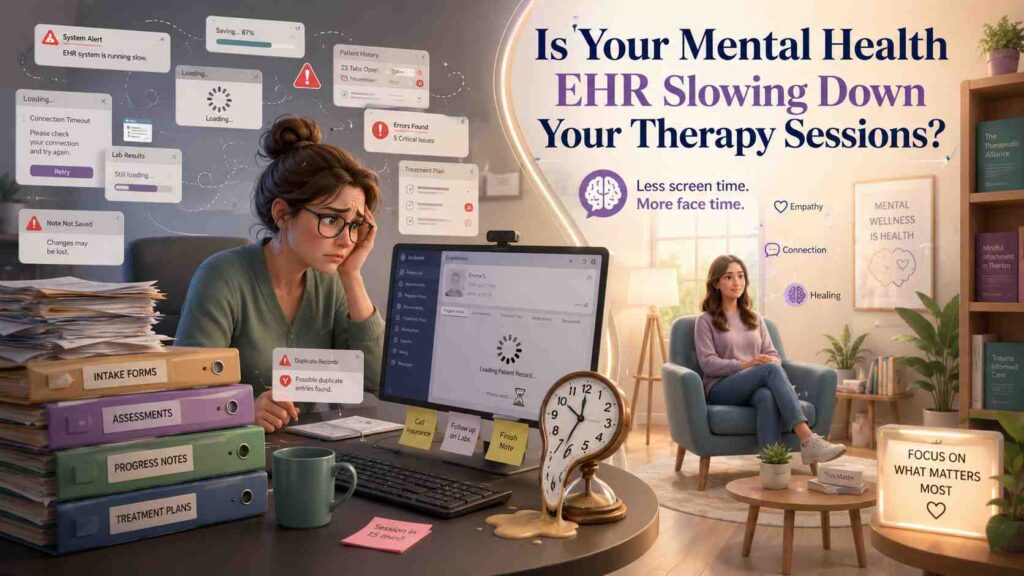
The primary goal of a best mental health EHR is to manage behavioural health workflows while effectively supporting mental health professionals. But even just having an EHR is not enough. The wrong system, one that is too rigid, too complex, or not designed for therapy workflows, can slow down sessions instead of supporting them. Research supports this concern. According to a 2025 observational study from Canada’s largest academic mental health hospital, inpatient mental health nurses spent an average of 19.3 minutes per patient per shift using the EHR. That is valuable time taken away from direct patient care. The wrong system does not just slow down workflows; it can fundamentally change how sessions are conducted and how care is delivered.
If your practice is dealing with weak reporting and analytics, frequent system downtime, high staff burnout, or communication bottlenecks, these are signs that your Mental Health EHR is causing the problem.
Let’s explore the signs in detail;
Frequent System Downtime: A system that crashes or lags mid-session does more than cause frustration. The therapeutic relationship you have developed with your patient is disrupted. If your EHR goes down regularly, your care quality goes down with it.
High Staff Burnout: Research says that mental health practitioners who use EHRs more after hours are at a much higher risk of burnout. If your team is completing notes at 10 p.m, the system is the problem.
Rigid Templates That Do Not Fit Therapy: Mental health documentation is narrative. If your mental health EHR forces therapists into checkboxes and dropdown menus, notes take longer and capture less. That directly affects care quality.
Repeated Data Entry: Entering the same patient information across multiple fields and screens is a daily frustration in poorly designed EHRs. It slows intake, increases errors, and exhausts staff.
Limited Visibility Into Patient Progress: If your EHR cannot provide meaningful reporting on treatment goals, behavioural patterns, and long-term outcomes, it becomes harder to evaluate patient progress and make informed care decisions.
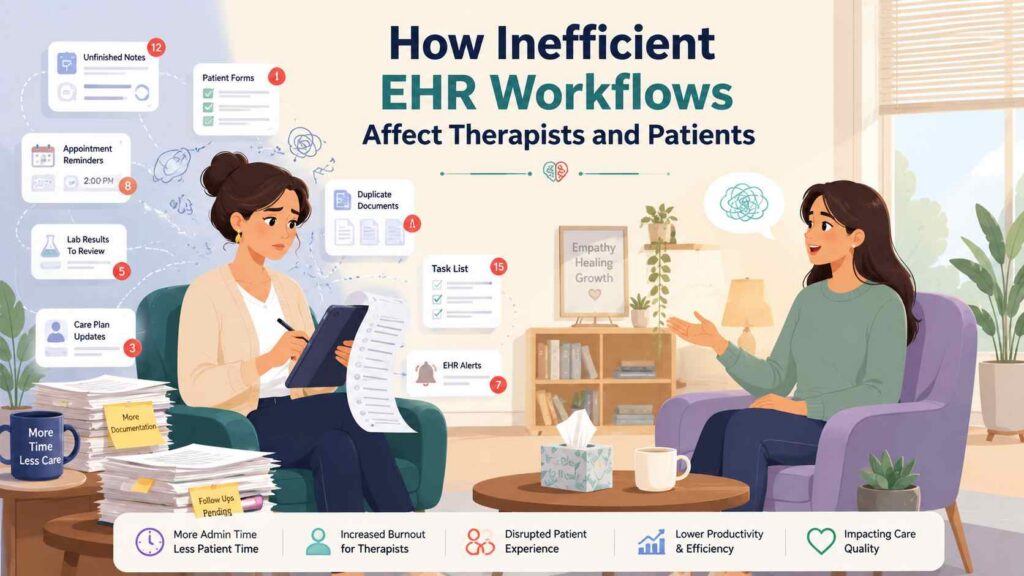
An inefficient Mental Health EHR affects both therapists and patients by disrupting workflows, increasing administrative burden, and reducing the quality of care experiences. For patients, it may lead to a less comfortable care experience.
Let’s explore in detail how a Mental Health EHR affects both patients and therapists.
Impact on Therapists
Increased Cognitive Load and Burnout: Poorly designed EHRs often require excessive clicking, navigation, and documentation, forcing therapists to spend additional hours on charting and administrative work. Over time, this contributes to fatigue, burnout, and reduced emotional presence during therapy sessions.
Workflow Workarounds: System inefficiencies cause clinicians to rely on personal shortcuts, paper notes, or delayed batch documentation, which increases the risk of documentation errors.
Task-Switching: Therapists often face constant interruptions to navigate the mental health EHR software during patient encounters, which breaks the continuity of care.
Impact on Patients
Less Face-to-Face Time: With therapists spending significant hours on administrative and EHR tasks for every hour of clinical care, patients receive less dedicated time and attention.
Impaired Patient-Provider Relationship: Constantly typing or looking at a computer screen during appointments distances the therapist from the patient, hindering trust and the therapeutic alliance.
Safety Risks: Treatment strategies may be affected as a result of lost medical histories or communication gaps caused by fragmented information and unclear mental health EHR layouts.
The EHR is not the only issue with many mental health practices. It is that the EHR, billing system, and documentation workflows often operate separately, creating inefficiencies that cost time, revenue, and staff productivity.
Outsource medical billing services from AmFac Medical Management, the best medical billing company USA, to help address Mental Health EHR challenges by integrating clinical and billing workflows into a single streamlined system. Our HIPAA-compliant, ONC-certified EHR Manager integrates directly with medical billing, reducing duplicate data entry and improving workflow efficiency. Features such as patient scheduling, secure patient communication, and flexible documentation tools help support smoother therapy sessions and better care coordination.
Beyond technology, our team understands the unique challenges of mental health billing, including therapy CPT codes, behavioural health authorizations, and telehealth requirements. For practices that already have mental health EHR software in place, our medical transcription and billing services work alongside existing systems, helping providers spend less time on paperwork and more time focused on patient care.
Mental Health EHR can slow down therapy sessions if it requires excessive documentation, repeated data entry, rigid workflows, or constant navigation during patient encounters. Your EHR should support your sessions, not slow them down. But when therapists spend more time managing software than engaging with patients, productivity declines and the quality of care can suffer. This is why many therapists deserve tools that work with them, not against them. At the best medical billing company USA, AmFac MM, our EHR management and billing services are designed to help mental health providers spend less time struggling with systems and more time focusing on what matters most: their patients.
One of the most serious problems with electronic health records (EHRs) is poor usability and data integrity issues. These challenges can affect patient safety, increase clinician burnout, and make it harder to deliver personalized, high-quality care.
The primary goal of a mental health EHR is to improve care coordination by providing healthcare providers with real-time access to accurate patient information. This helps streamline communication, reduce documentation errors, support informed clinical decisions, and meet compliance and reporting requirements.
A major mental health EHR challenge is limited support for behavioural health privacy regulations. Without proper access controls, audit trails, and consent tracking, organizations risk unauthorized data access, compliance violations, and loss of patient trust.
Collect visitor’s submissions and store it directly in your Elementor account, or integrate your favorite marketing & CRM tools.
Privacy Policy
Your privacy is very important to us. This Privacy Policy explains how we collect, use, and protect your information when you interact with our services, website, or communications.
Information We Collect
We may collect personal information that you provide directly to us, including but not limited to:
How We Use Your Information
We use the information we collect to:
Information Sharing
We do not sell or share your personal information with third parties for their marketing or promotional purposes.
No mobile information will be shared with third parties/affiliates for marketing/promotional purposes. All the above categories exclude text messaging originator opt-in data and consent; this information will not be shared with any third parties.
SMS Disclaimer
By providing your telephone number and submitting a form on our website or through other channels, you consent to receive SMS text messages from us.
Data Security
We use reasonable safeguards to protect your personal information from unauthorized access, disclosure, alteration, or destruction.
Updates to This Privacy Policy
We may update this Privacy Policy from time to time. Any changes will be posted on this page with an updated effective date.
Contact Us
If you have any questions about this Privacy Policy or our SMS practices, please contact us:
AmFac Medical Management
info@amfacmm.com
+1(877) 443-3655