
Liked this post? Share with others!
Credentialing in medical billing involves verifying provider qualifications, maintaining accurate information, completing payer enrollment, and keeping credentials current. Professional medical credentialing services help manage these requirements efficiently and reduce the risk of errors or delays. When the process is poorly managed, the effects can go beyond paperwork and create delays in provider onboarding, payer participation, and reimbursement. The AMA describes credentialing, privileging, and payer enrollment as separate but connected processes, noting that delays can postpone when physicians can begin seeing patients and billing for services.
CAQH allows providers and practices to maintain and share professional and practice information with participating health plans for credentialing and enrollment. A reliable credentialing provider should use this information effectively by keeping records accurate and up to date, monitoring application progress, tracking renewal deadlines, communicating status clearly, and addressing issues before they affect payer participation or billing. When these responsibilities are consistently missed, it may be a sign that the practice needs to reevaluate its credentialing provider.
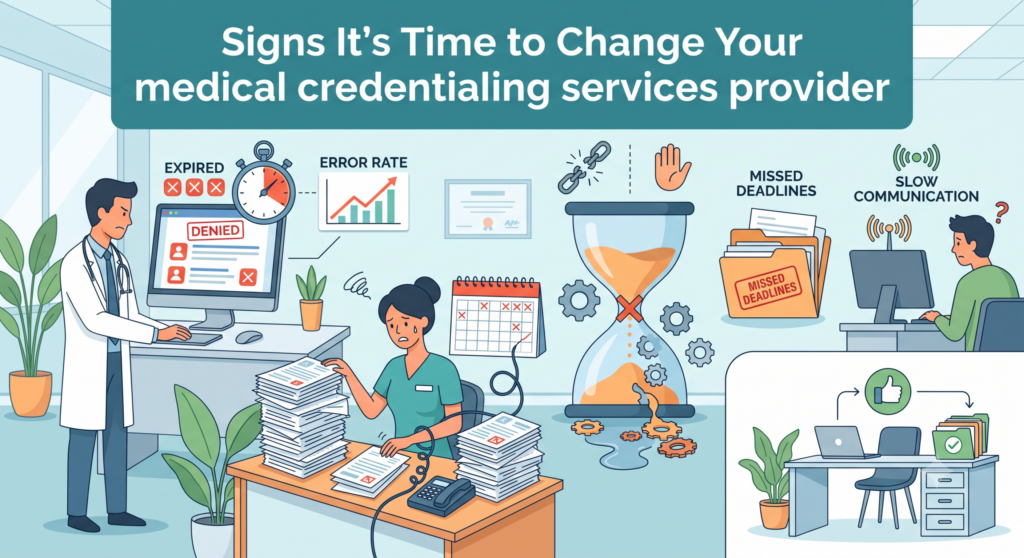
Even after outsourcing credentialing services, if your practice continues to face delays in applications and updates, inaccurate provider information, or repeated follow-ups, it may be a sign that your current provider is no longer meeting your needs.
Let’s explore the key signs that it may be time to change your medical credentialing services provider.
If your practice repeatedly has to ask where an application stands, the problem may be a lack of proactive tracking. A reliable credentialing in medical billing process should provide clear visibility into submitted applications, pending requirements, payer responses, and next steps. When that visibility is missing, practice staff may spend unnecessary time requesting updates and following up with the credentialing provider instead of focusing on patient care and other administrative responsibilities.
The American Medical Association notes that physician credentialing and privileging can take several months, with timelines affected by factors such as missing information, verification requirements, licensing issues, and payer processing. However, repeated delays without clear explanations or proactive follow-up can indicate a problem with your credentialing provider’s process. These delays may create a gap between hiring a provider and being fully credentialed to bill payers for their services, potentially affecting practice revenue and scheduling.
Your medical billing service should not repeatedly discover that a provider’s payer enrollment is incomplete only after claims create problems. Credentialing and billing are closely connected: enrollment determines whether providers can bill and receive payment from applicable payers. When outsourced medical credentialing services and billing teams operate without coordination, the practice can spend time investigating claims that could have been prevented through better enrollment management.
Errors in addresses, licenses, NPI information, specialties, affiliations, or other enrollment data can create additional requests and corrections. CMS requires Medicare providers to keep enrollment information current and report certain changes within specific timeframes. An inaccurate record can trigger rework and may create problems when payer or enrollment information needs to match across systems.
Credentialing responsibilities continue even after the initial approval. Medicare, for example, generally requires physicians and other providers to revalidate enrollment periodically, and CMS warns that late revalidation can result in held payments or deactivated billing privileges. This can significantly impact your practice because a provider who misses an important deadline can create a much larger operational problem than a simple administrative delay.
If you are experiencing several of these signs consistently, it may be time to reevaluate your medical credentialing specialist. Poor credentialing management can cost money while also creating additional work for your staff.
Before switching to another medical credentialing services provider, evaluate the process rather than relying only on promises about speed.
Look for a provider that offers:
CMS’s PECOS system, for example, allows providers to review enrollment information, submit applications, update records, and complete revalidation electronically. The right medical credentialing services provider should therefore make these processes easier to manage, not make the practice chase information about them.
Changing your medical credentialing services provider should not be based on one delayed application. The stronger reason to switch is a consistent pattern of poor communication, inaccurate information, missed deadlines, weak tracking, or problems that eventually affect billing and operations. If your current provider creates more follow-up work than it removes, it may be time to evaluate whether a more proactive credentialing partner would better support your practice.
AmFac Medical Management supports practices with proactive credentialing and payer enrollment, tracking applications, renewals, and deadlines so problems get caught before they affect billing. If your current credentialing process is creating more follow-up work than it removes, contact us to see how we can help.
Collect visitor’s submissions and store it directly in your Elementor account, or integrate your favorite marketing & CRM tools.
Privacy Policy
Your privacy is very important to us. This Privacy Policy explains how we collect, use, and protect your information when you interact with our services, website, or communications.
Information We Collect
We may collect personal information that you provide directly to us, including but not limited to:
How We Use Your Information
We use the information we collect to:
Information Sharing
We do not sell or share your personal information with third parties for their marketing or promotional purposes.
No mobile information will be shared with third parties/affiliates for marketing/promotional purposes. All the above categories exclude text messaging originator opt-in data and consent; this information will not be shared with any third parties.
SMS Disclaimer
By providing your telephone number and submitting a form on our website or through other channels, you consent to receive SMS text messages from us.
Data Security
We use reasonable safeguards to protect your personal information from unauthorized access, disclosure, alteration, or destruction.
Updates to This Privacy Policy
We may update this Privacy Policy from time to time. Any changes will be posted on this page with an updated effective date.
Contact Us
If you have any questions about this Privacy Policy or our SMS practices, please contact us:
AmFac Medical Management
info@amfacmm.com
+1(877) 443-3655