
Liked this post? Share with others!
Medical billing is more than just paperwork and a few bills. It offers submitting claims to Insurance verification, converting patient treatments into standardized billing codes, filing claims with insurance providers, monitoring claim rejections, and charging patients. These tasks cannot be handled by a team alone; they require the right technology to support them. That is where medical billing software comes in.
It automates some of the most time-consuming parts of the revenue cycle, allowing staff to work faster and with fewer errors. However, even as more practices adopt top medical billing software for small businesses, average healthcare claim denial rates reached nearly 12% in 2025, creating significant financial pressure for providers.
Medical billing software is a powerful tool, but it is only effective when the people using it can manage it properly. Without the right processes, training, and oversight, medical billing software for small businesses can still contribute to revenue leakage rather than prevent it. Over-reliance on automation can also lead teams to overlook important front-end tasks such as eligibility verification, resulting in errors that affect the entire revenue cycle.
Even with software in place, 15–20% of claims are still denied on first submission, according to MGMA 2024. The reason is simple. Software can automate a process, but it cannot fix the problems that feed into that process. Wrong information entered at intake, missed prior authorizations, outdated payer rules- software flags these issues sometimes, but it does not resolve them on its own.
The limitations of medical billing software can have a direct impact on a practice’s financial performance. Industry experts also point out that while automation can reduce simple administrative errors, it often struggles with payer-specific policy changes, authorization nuances, and complex denial resolution workflows. As denial complexity increases, practices that rely only on top medical billing software for billing companies may still experience delayed reimbursements, rising accounts receivable days, missed follow-ups, and preventable revenue loss.
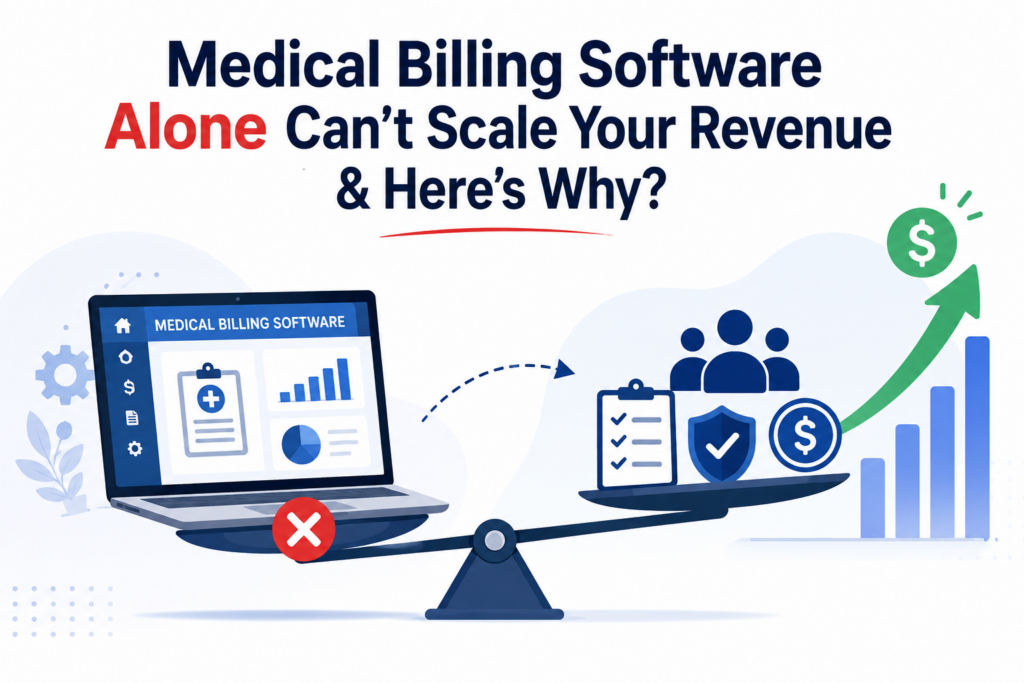
Revenue growth in a medical practice does not happen simply because billing software is installed. While medical billing software can automate routine tasks like data entry, claim formatting, and submission tracking, it cannot actively manage the complex processes that determine whether revenue is collected, delayed, or lost. Sustainable growth requires more than automation. It requires experienced professionals who can verify eligibility, ensure coding accuracy, follow up on unpaid claims, reduce denials, and optimize every stage of the revenue cycle.
Take eligibility verification and pre-authorization, for example. These issues must be resolved before care is delivered. While software can automate parts of the process, resolving discrepancies, obtaining approvals, and addressing payer requirements often requires human intervention. When these steps are missed, claims are more likely to be delayed or denied. Instead of waiting for these issues to turn into denials, AmFac Medical Management identifies and resolves them early, helping practices maintain a cleaner claims process and a healthier revenue cycle.
Then there is medical coding. Coding is not data entry. It is translating an entire patient encounter into precise, universally accepted codes that directly determine whether a claim gets paid in full or rejected. One wrong code, one missing modifier, and the revenue is either delayed or lost. This cannot be handled by medical billing software alone; it requires trained human expertise. This is where AmFac MM helps medical practices by combining advanced billing technology with experienced coding professionals who identify potential issues before claims are submitted, helping maximize reimbursement and minimize costly errors.
Patient collections are another area where technology alone falls short. Effective collections require transparent estimates, upfront payment strategies, and consistent communication throughout the patient journey. While software can generate statements and reminders, improving collection rates often depends on proactive follow-up and patient engagement.
This is where outsourced medical billing services by the best medical billing companies in the USA, like AmFac MM, make the difference. The goal is not to replace technology but to combine it with experienced revenue cycle specialists who know how to act when issues arise.
Medical billing software is an important part of an efficient revenue cycle, but technology alone does not create revenue growth. Today’s revenue cycle is too complex, too dynamic, and too critical to be left entirely to automation. Payer rules change, claims get denied, documentation gaps create revenue leakage, and no software can resolve these issues on its own. This is why many practices turn to outsource medical billing services for expert support beyond automation. As one of the best medical billing companies in the USA, AmFac MM Medical Billing combines advanced technology with experienced revenue cycle specialists who actively manage claims, reduce denials, improve collections, and protect revenue at every stage. Instead of simply providing a tool, AmFac MM acts as a complete revenue cycle partner, helping practices spend less time chasing claims and more time focusing on growth.
There is no single “most used” medical billing software globally, as the market is highly fragmented.
Using medical billing software typically involves a six-step workflow: entering patient information, verifying insurance eligibility, assigning accurate medical codes, submitting claims to payers, posting payments received, and tracking and resolving claim denials to support a smoother revenue cycle.
Collect visitor’s submissions and store it directly in your Elementor account, or integrate your favorite marketing & CRM tools.
Privacy Policy
Your privacy is very important to us. This Privacy Policy explains how we collect, use, and protect your information when you interact with our services, website, or communications.
Information We Collect
We may collect personal information that you provide directly to us, including but not limited to:
How We Use Your Information
We use the information we collect to:
Information Sharing
We do not sell or share your personal information with third parties for their marketing or promotional purposes.
No mobile information will be shared with third parties/affiliates for marketing/promotional purposes. All the above categories exclude text messaging originator opt-in data and consent; this information will not be shared with any third parties.
SMS Disclaimer
By providing your telephone number and submitting a form on our website or through other channels, you consent to receive SMS text messages from us.
Data Security
We use reasonable safeguards to protect your personal information from unauthorized access, disclosure, alteration, or destruction.
Updates to This Privacy Policy
We may update this Privacy Policy from time to time. Any changes will be posted on this page with an updated effective date.
Contact Us
If you have any questions about this Privacy Policy or our SMS practices, please contact us:
AmFac Medical Management
info@amfacmm.com
+1(877) 443-3655