
Liked this post? Share with others!
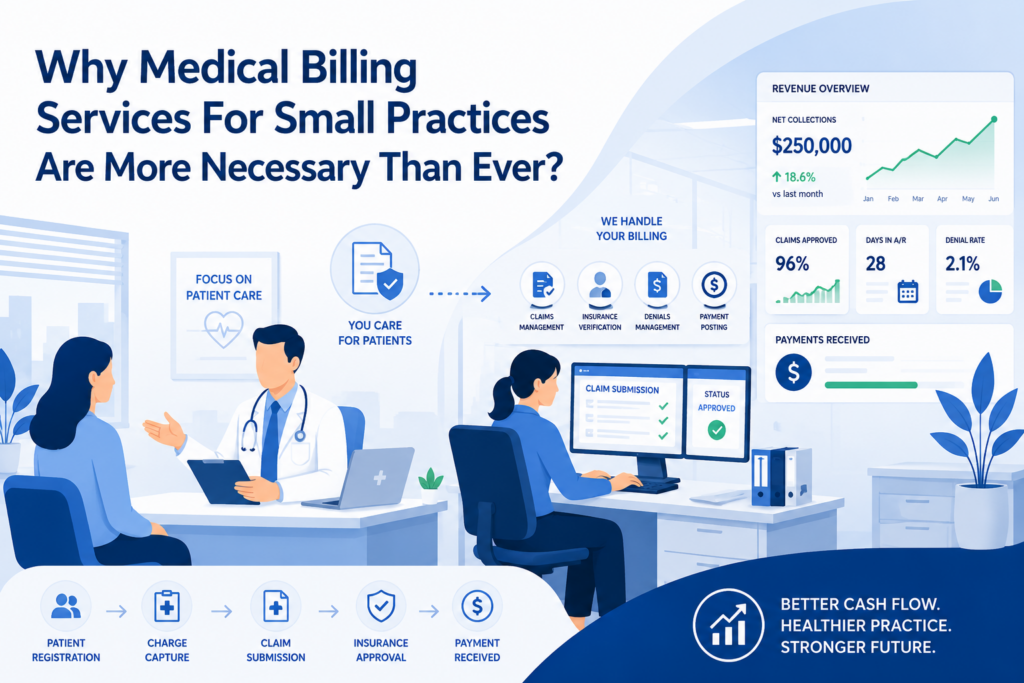
Medical billing services for small practices help manage critical revenue cycle tasks such as medical coding, claims submission, payment posting, denial management, and reimbursement tracking. The increasing complexity of healthcare billing and insurance has made these services even more crucial for independent practices. A small practice is more affected by billing mistakes than ever before because there is often no large financial cushion to absorb lost revenue. The financial pressure on small practices continues to grow. Industry reports show that operating costs increased by 11.1% from 2024 to 2025, while the Medicare conversion factor decreased by 2.8%, making it more difficult for independent providers to maintain healthy margins. At the same time, many small practices are expected to manage growing billing demands with limited staff and resources. This is why medical billing services for small practices are no longer just a want but a critical need to maintain their financial stability and long-term growth.
Practices that do not use medical billing services for small practices often face challenges such as staff shortages, complex insurance requirements, claim denials, and shrinking profit margins. These difficulties may put more strain on practice employees and providers, cause cash flow problems, and add to the administrative burden. Let’s explore these challenges in detail.
Staff and expertise gaps: Small teams can’t always afford certified coders or dedicated billing managers. Mistakes in CPT or ICD coding create denied claims and delayed payments.
Frequent regulatory updates: Payer rules, telehealth policies, and compliance standards change often. Practices without continuous training fall behind.
High denial rates: Industry averages show denial rates of 5–10% for outpatient claims; for under-resourced practices, it’s often higher. Each denial requires time to appeal.
Cash flow pressure: Longer days in accounts receivable (AR) and slow payments affect payroll, supplies, and growth.
Patient billing complexity: High-deductible plans and surprise billing rules mean more patient statements and payment plans to manage, something admin staff may not be equipped to handle efficiently.
Best practices to mitigate these challenges include regular staff training, using up-to-date EHR-billing integrations, and tracking denial reasons to fix root causes. Many small practices find that to scale sustainably they need dedicated billing expertise.

Medical billing services for small practices are more important because revenue cycle management has become specialized and essential. Professional billers increase clean claims, reduce denials, and speed up reimbursements. Let’s explore in detail.
Outsourcing medical billing brings specialized knowledge and technologies that small practices rarely have in-house. A professional billing partner such as AmFac Medical Management, one of the best medical billing companies in the USA, uses trained coders, payer-specific rules, and denial-management workflows to keep claims flowing. Studies have shown outsourcing can improve collection rates by 5–15% and reduce AR days significantly. The outsourced medical billing company also monitors regulatory changes and maintains compliance, cutting legal and financial risk.
Other benefits include:
However, selecting the best medical billing services for small practices matters. Look for transparent pricing, proven KPIs (clean claim rate, days in AR, denial rate), HIPAA compliance, and seamless EHR integration. Practices often achieve the best results when they partner with a billing company that combines experienced revenue cycle professionals with technology-driven workflows designed to reduce denials and accelerate reimbursements. This is exactly the approach followed by AmFac MM, which helps small practices improve billing performance through proactive denial management, accurate claim processing, and end-to-end revenue cycle support.
Medical billing is no longer a side task; it’s a strategic function. For small practices facing staffing limits, complex regulations, and cash-flow pressures, outsourcing to specialized medical billing services for small practices delivers operational relief and better revenue outcomes. When selecting a partner, compare the best medical billing services for small practices on experience, technology, transparency, and performance. AmFac MM, the best medical billing company in the USA, helps small practices navigate these challenges. They offer tailored billing solutions, smooth EHR integration, and dedicated support to improve collections and reduce denials. If you’re planning to outsource medical billing, evaluate potential partners by reviewing their performance metrics, pricing transparency, and ability to demonstrate measurable results.
To choose a medical billing service for a small practice, look beyond claims processing alone. The best provider should offer accurate coding, denial management, transparent reporting, responsive support, and solutions that help reduce administrative burden.
The best medical billing services for small healthcare practices are those that offer accurate claim submission, proactive denial management, transparent reporting, HIPAA compliance, and dedicated accounts receivable follow-up.
Collect visitor’s submissions and store it directly in your Elementor account, or integrate your favorite marketing & CRM tools.
Privacy Policy
Your privacy is very important to us. This Privacy Policy explains how we collect, use, and protect your information when you interact with our services, website, or communications.
Information We Collect
We may collect personal information that you provide directly to us, including but not limited to:
How We Use Your Information
We use the information we collect to:
Information Sharing
We do not sell or share your personal information with third parties for their marketing or promotional purposes.
No mobile information will be shared with third parties/affiliates for marketing/promotional purposes. All the above categories exclude text messaging originator opt-in data and consent; this information will not be shared with any third parties.
SMS Disclaimer
By providing your telephone number and submitting a form on our website or through other channels, you consent to receive SMS text messages from us.
Data Security
We use reasonable safeguards to protect your personal information from unauthorized access, disclosure, alteration, or destruction.
Updates to This Privacy Policy
We may update this Privacy Policy from time to time. Any changes will be posted on this page with an updated effective date.
Contact Us
If you have any questions about this Privacy Policy or our SMS practices, please contact us:
AmFac Medical Management
info@amfacmm.com
+1(877) 443-3655