
Liked this post? Share with others!
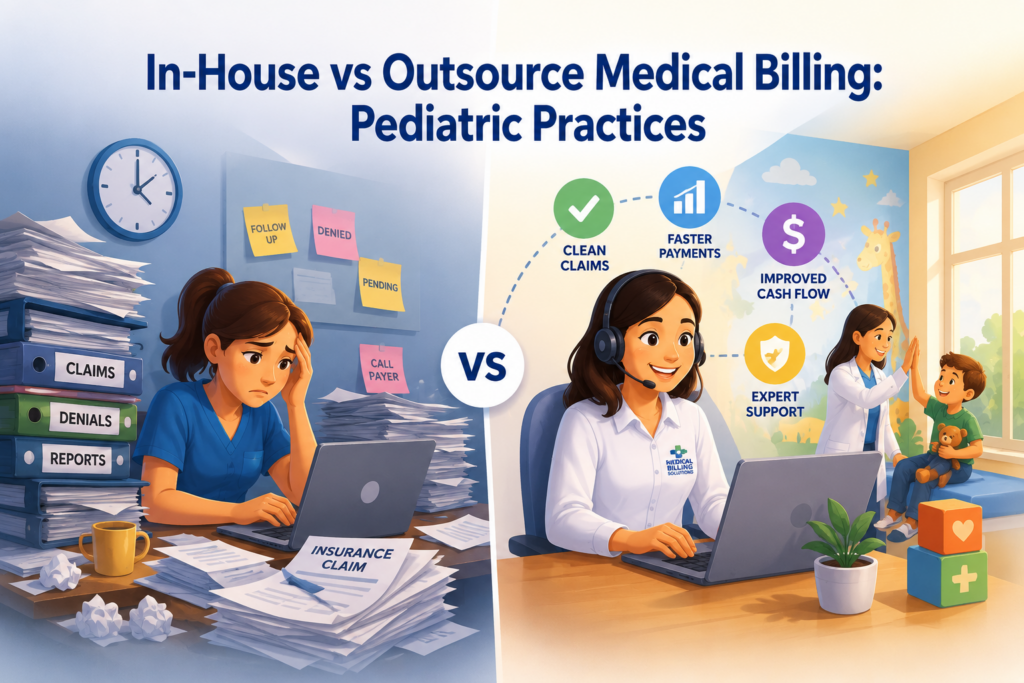
One denied claim for a newborn visit or vaccine administration may seem minor, but repeated billing errors can significantly affect a pediatric practice’s cash flow. Choosing whether to keep billing in-house or outsource medical billing depends on your practice size, claim volume, staffing, and the complexity of pediatric coding. The right approach should reduce denials, improve collections, and allow providers to spend more time caring for children instead of resolving billing issues.
According to industry estimates, running an in-house pediatric billing operation typically costs practices $135K–$206K annually when staff salaries, coding gaps, and revenue lost to delayed claims are taken into account. In comparison, outsourced medical billing services usually cost around 6% of collections, and practices that make the switch often see an 8–12% increase in revenue, clean claim rates above 97%, and relief from the ongoing cycle of billing staff turnover and retraining. This shows that, from a revenue perspective, outsourced medical billing services for pediatric practices can be a win-win solution.
Many practices choose to outsource medical billing when internal resources cannot keep pace with billing demands.
Still unsure whether your practice needs to outsource billing? Here’s a practical checklist from AmFac Medical Management’s experts. If you’re seeing any of the signs below, it’s likely time to explore outsourcing:
In-house billing can work well for pediatric medical billing when a practice has experienced billing professionals, manageable patient volume, and the resources to stay current with coding updates.
However, even experienced teams can struggle when:
Many practices compare only salaries when evaluating costs. However, the total expense extends well beyond payroll.
In-House Billing | Outsource Medical Billing |
Employee salaries | Service fees |
Staff benefits | No employee benefits |
Ongoing coding education | Included expertise |
Billing software licenses | Usually included by the vendor |
IT maintenance | Minimal internal IT burden |
Recruitment and onboarding | No hiring costs |
Employee turnover | Managed by the billing company |
Productivity losses during staff absences | Dedicated billing team ensures continuity |
A hidden cost many pediatric practices overlook is billing disruption caused by staff turnover. Even a short vacancy can delay claim submissions, increase A/R days, and reduce monthly collections.
Key Performance Indicators (KPIs) provide a measurable way to evaluate how efficiently a medical billing process supports the revenue cycle. The better choice depends on your practice’s operational needs rather than a universal answer.
The table below compares how in-house and outsourced medical billing typically perform across the KPIs that have the greatest impact on practice revenue and operational efficiency.
KPI | In-House Billing | Outsourced Billing |
|---|---|---|
Billing Control | High | Moderate with regular reporting |
Staffing Responsibility | High | Low |
Scalability | Limited by hiring | Easily scalable |
Coding Expertise | Depends on staff training | Specialised billing professionals |
Administrative Workload | Higher | Lower |
Claim Follow-Up | Internal responsibility | Managed by billing partner |
Technology Investment | Practice-funded | Often included |
Business Continuity | Affected by staffing changes | More consistent |
Practices prioritising direct oversight may prefer in-house billing, while those seeking scalability and reduced administrative burden often find outsourcing a better long-term fit.
Outsourcing medical billing improves revenue cycle performance for pediatric practices by creating a structured workflow that reduces billing errors, accelerates claim processing, strengthens denial management, and improves reimbursement consistency. Instead of reacting to claim denials, experienced billing teams identify and resolve issues before claims are submitted, helping practices maintain a healthier revenue cycle.
At AmFac Medical Management, we follow a structured revenue cycle workflow designed to improve billing accuracy and reduce administrative burden for pediatric practices.
This structured workflow helps identify documentation, coding, and eligibility issues before claims reach the payer, reducing preventable denials while improving reimbursement efficiency.
This Benefits Pediatric Practices by:
Whether in-house or outsourced medical billing is the better choice depends on your pediatric practice’s staffing, billing expertise, growth goals, and operational capacity. While in-house billing offers greater control, outsourced medical billing often provides specialised coding expertise, stronger denial management, improved revenue cycle performance, and reduced administrative burden. AmFac Medical Management, the best medical company in the USA, helps pediatric practices streamline billing operations, maximise reimbursements, and spend more time delivering quality care to their young patients.
Collect visitor’s submissions and store it directly in your Elementor account, or integrate your favorite marketing & CRM tools.
Privacy Policy
Your privacy is very important to us. This Privacy Policy explains how we collect, use, and protect your information when you interact with our services, website, or communications.
Information We Collect
We may collect personal information that you provide directly to us, including but not limited to:
How We Use Your Information
We use the information we collect to:
Information Sharing
We do not sell or share your personal information with third parties for their marketing or promotional purposes.
No mobile information will be shared with third parties/affiliates for marketing/promotional purposes. All the above categories exclude text messaging originator opt-in data and consent; this information will not be shared with any third parties.
SMS Disclaimer
By providing your telephone number and submitting a form on our website or through other channels, you consent to receive SMS text messages from us.
Data Security
We use reasonable safeguards to protect your personal information from unauthorized access, disclosure, alteration, or destruction.
Updates to This Privacy Policy
We may update this Privacy Policy from time to time. Any changes will be posted on this page with an updated effective date.
Contact Us
If you have any questions about this Privacy Policy or our SMS practices, please contact us:
AmFac Medical Management
info@amfacmm.com
+1(877) 443-3655