
Liked this post? Share with others!
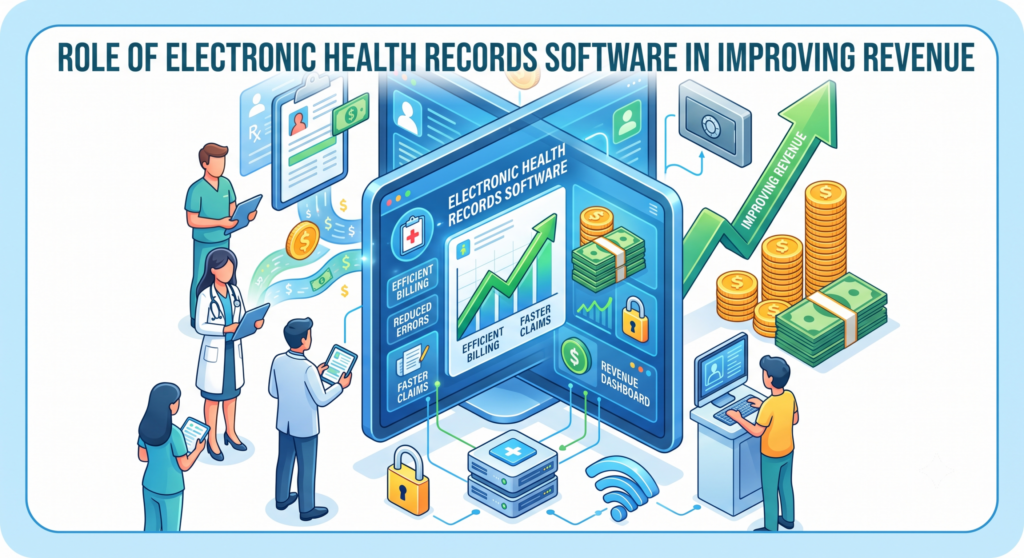
An electronic health records software contains clinical and administrative information such as patient demographics, medical history, diagnoses, medications, progress notes, and other information generated during care. CMS notes that EHRs can automate access to information and help streamline clinical workflows by improving documentation, charge capture, coding accuracy, and access to information. Which eventually supports the revenue cycle.
This workflow looks like:
Patient encounter → documentation → charge capture → coding → claim submission → payer processing → payment posting
When information is accurately captured at the beginning of this process, billing staff have a better foundation for completing the later steps. Thus revenue problems can begin before a claim is ever submitted. If a service is poorly documented, not captured, or contains incomplete information, the billing team may have to correct the issue later, or may not be able to bill the service appropriately at all.
Simply having an EHR system does not guarantee better financial performance. If the team is not experienced enough to use it effectively, the practice may not achieve its full benefits.
Common problems include:
The AMA continues to identify workflow interruptions, excessive EHR-related tasks, and poor interoperability as challenges that can limit EHR efficiency. Poorly designed workflows may even add administrative work instead of reducing it. Therefore, the goal should not be to automate everything, but to eliminate unnecessary manual steps while maintaining accurate clinical documentation and billing controls.
EHR software does not improve the revenue cycle directly. Instead, it strengthens the processes that support it, including documentation accuracy, access to complete patient information, efficient record management, and integration with RCM tools.
Here’s how EHR software can support these areas and contribute to a more efficient revenue cycle:
The medical record provides the foundation for coding and billing. CMS advises that documentation should support the CPT, HCPCS, and ICD-10-CM codes reported on a claim. An EHR can provide structured templates, required fields, clinical notes, and other documentation tools that help providers record relevant information during the encounter.
Better-supported documentation can reduce avoidable clarification and correction work and gives coders and billers the information needed to report services accurately. However, templates should not encourage unnecessary or copied documentation. The record still needs to accurately reflect the care provided.
Charge capture is the process of identifying billable services provided during a patient encounter and ensuring they enter the billing workflow. An electronic health records software can connect clinical documentation with charge workflows so that services are less likely to remain outside the billing process. Missed charges represent services the practice already provided but has not converted into billed revenue. Monitoring unbilled encounters and charge lag can help identify this type of leakage.
EHR systems can give billing teams access to diagnoses, procedures, clinical notes, medications, and other relevant information from the encounter. This is particularly important because coding must reflect the services actually provided and supported by documentation. CMS also emphasizes that coding systems need to be used consistently for claims processing. When coders have complete information at the start, fewer claims may need to be returned to the clinical team for clarification, reducing delays and administrative rework. An EHR can support accurate coding, but it does not replace qualified coding judgment.
When clinical and billing information is stored electronically and can move between connected systems, staff may spend less time searching for paper records or requesting missing information.
CMS reports that electronic medical documentation processes can reduce administrative burden and improve payment turnaround time in certain Medicare workflows. Faster access to required documentation can help billing teams respond more quickly when a payer requests supporting information or when a claim needs review.
The financial value of an electronic health records software increases when it works effectively with practice-management, clearinghouse, payment, eligibility, and other revenue-cycle systems.
Electronic transactions can help automate the movement of information between providers and payers. CMS notes that electronic data interchange allows transactions to be processed faster and at lower cost than some manual processes. Better integration can reduce duplicate data entry and manual handoffs, giving staff more time to focus on exceptions such as denials, unpaid claims, and accounts receivable.
Electronic Health Records (EHR) software can support revenue improvement by strengthening the connection between patient care and the revenue cycle. Better documentation, more complete charge capture, accessible coding information, electronic workflows, and system integration can help reduce avoidable revenue leakage and administrative rework.
However, this does not mean that EHR software alone can improve your practice’s revenue. If you do not understand what is affecting your revenue, financial leakage can continue even with an effective EHR system. A deeper analysis can help identify the root causes and determine whether changes to your EHR workflows or other revenue cycle processes are needed.
If you need professional help identifying and addressing these issues, AmFac Medical Management is just one click away.
EHR software improves revenue by reducing billing errors, supporting accurate documentation, speeding up claim submission, and helping practices track payments.
EHRs keep clinical and patient information organized, helping billing teams use accurate documentation and reduce data-entry errors.
Collect visitor’s submissions and store it directly in your Elementor account, or integrate your favorite marketing & CRM tools.
Privacy Policy
Your privacy is very important to us. This Privacy Policy explains how we collect, use, and protect your information when you interact with our services, website, or communications.
Information We Collect
We may collect personal information that you provide directly to us, including but not limited to:
How We Use Your Information
We use the information we collect to:
Information Sharing
We do not sell or share your personal information with third parties for their marketing or promotional purposes.
No mobile information will be shared with third parties/affiliates for marketing/promotional purposes. All the above categories exclude text messaging originator opt-in data and consent; this information will not be shared with any third parties.
SMS Disclaimer
By providing your telephone number and submitting a form on our website or through other channels, you consent to receive SMS text messages from us.
Data Security
We use reasonable safeguards to protect your personal information from unauthorized access, disclosure, alteration, or destruction.
Updates to This Privacy Policy
We may update this Privacy Policy from time to time. Any changes will be posted on this page with an updated effective date.
Contact Us
If you have any questions about this Privacy Policy or our SMS practices, please contact us:
AmFac Medical Management
info@amfacmm.com
+1(877) 443-3655