
Liked this post? Share with others!
Mental health billing has several requirements that make accuracy particularly important. Many behavioral health services are time-based, and the documentation needs to support the service and code reported. For example, CMS requires documentation of the time spent for several psychotherapy codes and expects the medical record to support the reported CPT/HCPCS and ICD-10-CM codes.
Mental health practices may also provide different types of services, including individual psychotherapy, family therapy, group therapy, psychiatric evaluations, medication management, and psychological testing. Each can involve different coding and documentation requirements.
The billing workflow can therefore involve:
This makes billing knowledge important, but workflow consistency is equally important. A practice can have experienced clinicians and still experience billing problems if documentation, coding, claims, and follow-up are not well coordinated. Given this complexity, many practices eventually face a similar decision: whether to manage billing internally or bring in outside support to handle it consistently.
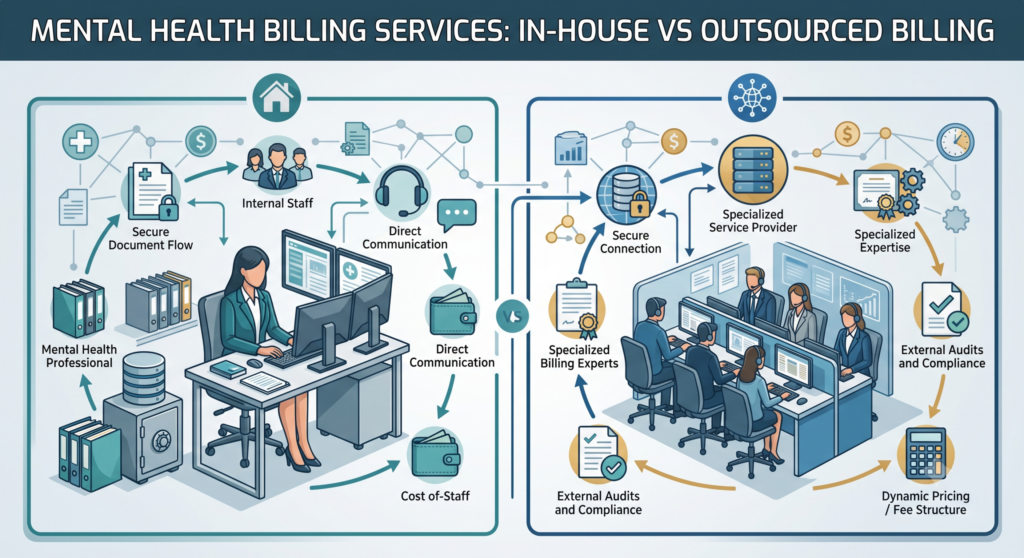
With in-house billing, the practice employs or assigns its own staff to manage revenue-cycle activities. Depending on the size of the practice, one person may handle several responsibilities, or separate employees may manage registration, claims, payment posting, and AR follow-up.
Advantages of in-house billing
Direct control: Practice leadership can directly manage billing priorities, processes, and staff.
Easy internal communication: Billing employees can communicate directly with providers and front-desk staff when information is missing.
Practice familiarity: Internal staff may have a strong understanding of the practice’s providers, services, patients, and workflows.
Challenges of in-house billing
The main challenge is maintaining the right level of expertise and staffing. The practice is responsible for hiring, training, supervising, and retaining billing employees. It also has to manage workload fluctuations, staff absences, technology, and ongoing changes in payer and billing requirements.
As claim volume increases, the practice may need additional staff or technology to keep up. An internal team can also become vulnerable when billing knowledge is concentrated in one or two employees. If an experienced employee leaves, the practice may suddenly lose important operational knowledge.
With outsourced medical billing services, an external company manages some or all of the practice’s revenue-cycle activities. The exact scope depends on the agreement, but services may include:
The practice continues to provide clinical care and remains responsible for the accuracy of its clinical documentation. The external billing team manages the agreed-upon administrative and revenue-cycle responsibilities.
Outsourcing mental health billing can improve practice cash flow by helping practices reduce avoidable claim rejections, accelerate reimbursement, and strengthen follow-up on unpaid claims. Industry sources report that practices outsourcing revenue cycle management may see 10% to 25% increases in collections, although actual results vary based on the practice’s existing billing processes, payer mix, claim volume, and denial rate.
Advantages of outsourcing
Access to specialized staff: A billing company may have employees experienced in healthcare billing and different payer workflows.
Scalability: An external team may be able to handle increased claim volume without the practice immediately hiring additional employees.
Reduced internal workload: Physicians and practice staff can spend less time on repetitive billing follow-up when those responsibilities are properly delegated.
Broader billing support: Depending on the provider, the practice may receive support across claims, denials, payment posting, and AR rather than relying on one internal employee.
Challenges of outsourcing
Outsourcing medical billing services also requires oversight. The practice needs to understand what the vendor is responsible for, how performance will be measured, how information will be communicated, and how patient data will be protected.
A billing company cannot correct every problem that originates inside the practice. Incomplete documentation, inaccurate patient information, or missed authorization requirements still need attention from the practice itself.
Factor | In-House Billing | Outsourced Billing |
Staff management | Practice handles hiring and training | Vendor manages billing staff |
Direct control | High | Requires vendor oversight |
Billing expertise | Depends on internal team | Depends on vendor’s expertise |
Scalability | May require additional hiring | Can often scale with volume |
Technology | Practice manages investment | May be provided or supported by vendor |
Communication | Direct internal communication | Requires defined communication channels |
Workload | Managed by practice staff | Billing workload is delegated |
Cost structure | Payroll, benefits, software, training, management | Vendor fees plus internal oversight |
Performance monitoring | Managed internally | Requires vendor reporting and review |
The important comparison is not simply which option costs less. A practice should compare the total cost of each model against the results it produces. An inexpensive internal billing process may not be efficient if claims are consistently delayed or AR is not being worked. Similarly, an outsourced service may not provide value if the vendor’s performance is poor or the practice lacks appropriate oversight.
For mental health practices considering whether to outsource medical billing or keep billing in-house, the best model is the one that consistently supports accurate claims, timely follow-up, a manageable administrative workload, and predictable revenue collection.
In-house billing may be a better fit when:
In this situation, replacing an effective internal process simply because outsourcing is available may not make sense.
Outsourcing may be worth considering when:
Before choosing a vendor, practices should evaluate its experience with mental health billing, reporting capabilities, denial and AR processes, technology integration, communication standards, and data-security practices.
Mental health billing software should also be evaluated carefully. Software can automate and organize parts of the billing workflow, but it does not replace trained staff or sound processes. A practice should assess whether its current technology actually reduces manual work and supports the workflow it needs.
Mental health billing involves coding, documentation, payer requirements, patient responsibility, and ongoing A/R management. Both in-house and outsourced billing can work, depending on a practice’s needs, staff capacity, costs, and billing performance.
For some practices, strengthening the internal team may be the better option. For others, outsourcing medical billing can provide additional expertise and capacity. AmFac Medical Management can support practices that need additional help with billing and revenue cycle management without replacing the practice’s internal oversight.
In-house billing is managed by the practice’s own staff, while outsourced billing is handled by an external medical billing company.
It depends on the practice’s size, workload, budget, staffing, and billing needs. Both models can work effectively when managed properly.
Collect visitor’s submissions and store it directly in your Elementor account, or integrate your favorite marketing & CRM tools.
Privacy Policy
Your privacy is very important to us. This Privacy Policy explains how we collect, use, and protect your information when you interact with our services, website, or communications.
Information We Collect
We may collect personal information that you provide directly to us, including but not limited to:
How We Use Your Information
We use the information we collect to:
Information Sharing
We do not sell or share your personal information with third parties for their marketing or promotional purposes.
No mobile information will be shared with third parties/affiliates for marketing/promotional purposes. All the above categories exclude text messaging originator opt-in data and consent; this information will not be shared with any third parties.
SMS Disclaimer
By providing your telephone number and submitting a form on our website or through other channels, you consent to receive SMS text messages from us.
Data Security
We use reasonable safeguards to protect your personal information from unauthorized access, disclosure, alteration, or destruction.
Updates to This Privacy Policy
We may update this Privacy Policy from time to time. Any changes will be posted on this page with an updated effective date.
Contact Us
If you have any questions about this Privacy Policy or our SMS practices, please contact us:
AmFac Medical Management
info@amfacmm.com
+1(877) 443-3655