
Liked this post? Share with others!
Physician practice management involves the systems, people, and workflows used to run the administrative and financial side of a medical practice.
This can include:
A practice management system can also automate several of these functions, including scheduling, patient registration, eligibility checks, and patient financial responsibility workflows. The important point is that these functions are connected. A problem in one area can create additional work in another.
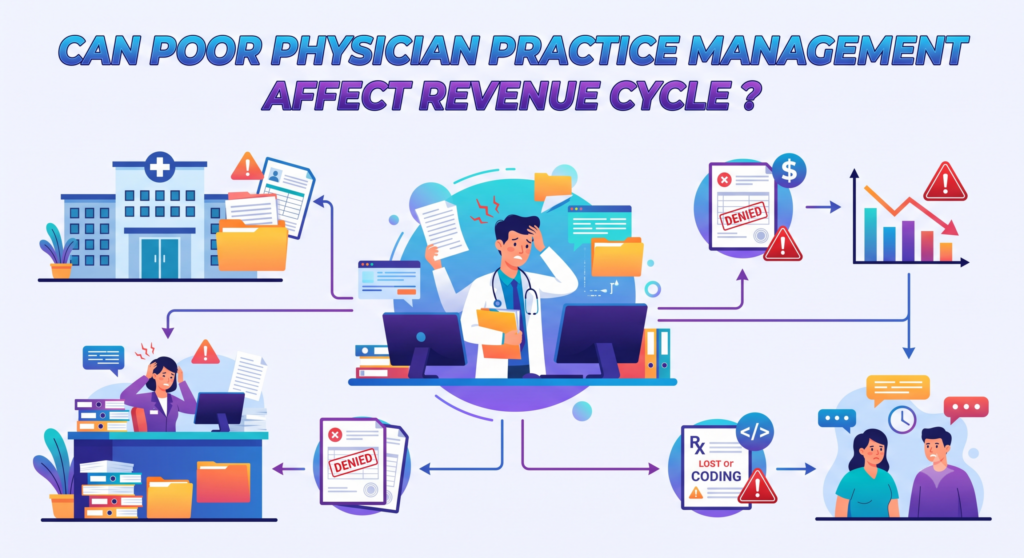
Poor physician practice management can affect the revenue cycle in several ways:
Revenue cycle performance starts with accurate patient information. Incorrect demographics, member IDs, payer information, or eligibility details can prevent claims from being processed correctly. A peer-reviewed RCM review identifies patient registration and insurance verification errors as common avoidable billing problems. These errors can lead to claim corrections, payer follow-up, and additional staff workload.
Physician documentation is another important link between patient care and revenue. If charts are not closed promptly, charges may not be captured and coded on time. The AMA identifies same-day chart closure as ideal and notes that prompt chart closure is a critical component of the revenue cycle. As a result, services may already have been provided while the related claim is still waiting to move forward. This creates a delay between the date of service and reimbursement.
Revenue cycle management cannot work efficiently when front-desk, clinical, coding, and billing teams operate in separate silos.
For example, a billing team may discover that an authorization is missing only after the service has already been provided. Similarly, coders may have to repeatedly contact physicians for incomplete documentation.
Poor communication can lead to more rework, slower claims processing, a higher administrative workload, and a greater risk of preventable denials.
Poor physician practice management can also affect what happens after a claim is submitted. If claims are not monitored regularly, rejected or denied claims may remain unresolved. The practice may also fail to identify recurring denial patterns and fix the underlying operational problem.
A recent MGMA Stat poll found that 60% of medical group leaders reported an increase in their practices’ claim denial rates, but only 11% had managed to bring those rates back down. That gap points to something specific: rising denials aren’t usually a one-time problem, they’re a sign that the same root cause is going unaddressed while individual claims get corrected one at a time.
Patient responsibility is an increasingly important part of practice revenue. If practices do not clearly communicate financial responsibility or have a consistent collection process, patient balances can remain outstanding. This can increase outstanding patient balances while also requiring additional staff time for statements, phone calls, payment reminders, and collection efforts.
A KFF/New York Times survey on medical bills found that a majority of patients, both those who had experienced billing problems (61%) and those who hadn’t (63%) said doctors rarely, if ever, discuss treatment costs or insurance coverage with them beforehand. That communication gap is often where the collection problem actually starts: a patient who doesn’t know what they owe until after the visit is far more likely to dispute, delay, or simply not pay the balance than one who was told upfront.
The biggest problem with poor physician practice management is that one small issue rarely stays isolated.
Consider a simple example:
Incorrect insurance information → claim rejection → staff correction → delayed resubmission → delayed payment → increased AR → additional follow-up work.
Now imagine the same issue occurring across dozens of patients every month. The financial impact comes not only from the delayed payment but also from the administrative time required to correct the problem.
This is why practices should look beyond individual denials and examine the workflow that produced them. The AMA recommends reviewing the process from chart closure through claim creation, claim submission, payer acceptance, and AR aging to identify where delays are occurring.
Improving revenue cycle performance does not always require a complete operational overhaul. Practices can start by tightening the workflows that have the greatest financial impact.
Standardize front-end processes : Verify demographics, insurance eligibility, benefits, authorization requirements, and patient responsibility before the appointment whenever possible.
Set clear documentation expectations: Establish reasonable timelines for chart completion and create a process for resolving documentation gaps quickly.
Connect clinical and billing workflows: Billing staff should have a clear way to communicate with physicians, clinical teams, and front-desk staff when information is missing or incorrect.
Track revenue cycle KPIs: Practice leaders should regularly review metrics such as:
HFMA identifies 30–40 days as the ideal target range for days in A/R, recommending that accounts over 90 days stay under 10% of total receivables. Crossing that threshold typically signals a specific bottleneck: claim submission delays, payer follow-up gaps, or denial-management issues that need direct attention.
Automate repetitive administrative work: Electronic eligibility verification, electronic claims, electronic remittance, and automated workflows can reduce unnecessary manual work. The 2024 CAQH Index estimates that fully electronic administrative workflows could unlock about $20 billion in annual savings across healthcare. For individual practices, this can mean less staff time spent on repetitive tasks, fewer administrative delays, and more time available for revenue-cycle and patient-focused work.
Poor physician practice management can affect the revenue cycle by increasing denials, delaying reimbursements, and causing revenue leakage. Incorrect registration, weak insurance verification, delayed documentation, poor team coordination, inefficient denial management, and weak patient collections can all create downstream revenue problems.
The strongest approach is to treat practice management and revenue cycle management as connected processes. When physician practices monitor the entire workflow, from patient registration to final payment, they can identify problems earlier, reduce preventable rework, improve cash flow, and protect revenue from services they have already provided.
For practices that consistently struggle to keep this workflow connected internally, outsourcing parts of the billing and revenue-cycle process is one way to bring that coordination back without adding to internal staff workload.
Poor practice management can lead to billing errors, delayed claims, more denials, slower payments, and lost revenue.
Yes. Poor scheduling can cause missed appointments, incomplete patient information, and workflow delays, which can affect revenue collection.
Collect visitor’s submissions and store it directly in your Elementor account, or integrate your favorite marketing & CRM tools.
Privacy Policy
Your privacy is very important to us. This Privacy Policy explains how we collect, use, and protect your information when you interact with our services, website, or communications.
Information We Collect
We may collect personal information that you provide directly to us, including but not limited to:
How We Use Your Information
We use the information we collect to:
Information Sharing
We do not sell or share your personal information with third parties for their marketing or promotional purposes.
No mobile information will be shared with third parties/affiliates for marketing/promotional purposes. All the above categories exclude text messaging originator opt-in data and consent; this information will not be shared with any third parties.
SMS Disclaimer
By providing your telephone number and submitting a form on our website or through other channels, you consent to receive SMS text messages from us.
Data Security
We use reasonable safeguards to protect your personal information from unauthorized access, disclosure, alteration, or destruction.
Updates to This Privacy Policy
We may update this Privacy Policy from time to time. Any changes will be posted on this page with an updated effective date.
Contact Us
If you have any questions about this Privacy Policy or our SMS practices, please contact us:
AmFac Medical Management
info@amfacmm.com
+1(877) 443-3655