
Liked this post? Share with others!
Medical credentialing means provider enrollment with insurance payers so you can bill and get reimbursed. Credentialing is the mandatory verification process where insurance companies confirm your qualifications, licenses, and practice details. Without credentialing, you cannot bill insurance, no reimbursement at all. According to Medallion’s 2025 Report in a survey of 580+ healthcare leaders, 69% of health systems and hospitals report losses of $1,000 to $5,000 per provider per day due to credentialing delays. Some hospitals report losses exceeding $1 million annually. These numbers highlight why timely provider enrollment is directly connected to financial performance. By reducing enrollment delays and helping providers become billable faster, outsourced medical credentialing services can play an important role in improving cash flow stability from the very beginning.
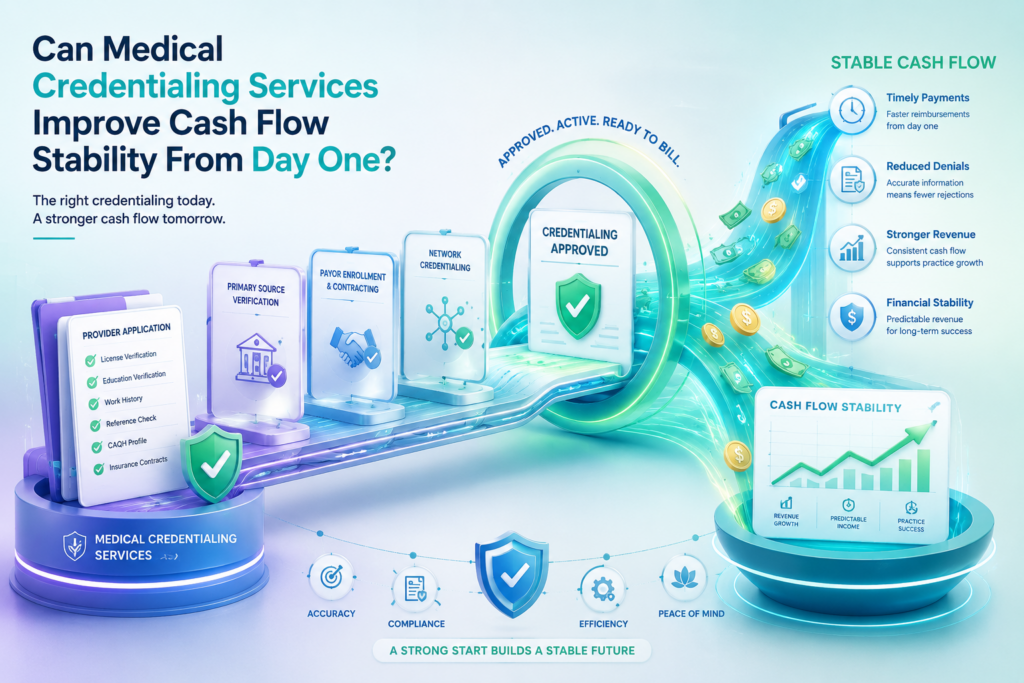
Medical Credentialing Services verify a healthcare provider’s qualifications and enrol them with insurance payers so they can legally bill for services and receive reimbursement. The process involves collecting provider information, validating credentials, submitting enrollment applications, and following up with payers until approval is received.
Let’s understand in detail how these services take place;
According to MGMA industry standards, credentialing delays average 90-120 days for new providers, with some payers taking up to 180 days (6 months). Many practices underestimate these timelines, resulting in months of paying salaries, benefits, and operational expenses without being able to bill insurance companies. This creates a severe cash flow crisis. Even a single provider sitting in a “pending” status can cost a practice anywhere from $83,000 to $122,000 over just a few months. That is why many practices outsource the medical credentialing services in the USA.
Providers Generate No Insurance Revenue
Until credentialing is approved, providers cannot bill most insurance payers for the services they deliver. Practices continue paying salaries, benefits, and operational costs, but the provider is unable to generate reimbursable revenue.
The Risk of Lost Revenue From Retroactive Billing
Many practices assume they can simply bill insurance companies once credentialing is approved. However, retroactive approvals are not guaranteed. If a payer refuses retroactive reimbursement, those services may become unrecoverable revenue losses.
Increased Claim Denials and Rework
Credentialing delays often create enrollment mismatches, missing payer information, and billing errors that lead to claim denials. Correcting and resubmitting these claims adds additional delays, administrative work, and revenue cycle disruption. And that’s where outsourced medical credentialing services help by streamlining payer enrollment, eliminating credentialing discrepancies, and supporting cleaner claims from the start.
Cash Flow Becomes Unpredictable
While reimbursement is delayed, practice expenses continue without interruption. Payroll, rent, technology costs, and vendor payments must still be covered, forcing some organizations to rely on cash reserves or short-term financing to bridge the gap.
Delayed Growth Opportunities
Credentialing bottlenecks can also limit a practice’s ability to onboard new providers, expand services, or accept additional patients, creating long-term financial consequences beyond the initial delay.
Outsourcing medical credentialing services can improve cash flow stability by ensuring faster approval, higher accuracy, and predictable timelines. Here’s how outsourcing the best medical credentialing services actually benefits you;
Faster Credentialing, Faster Revenue: Working with an experienced outsourcing partner can reduce average credentialing time by 30–50%. That means providers get approved sooner, start seeing patients sooner, and start generating revenue sooner. Every week saved is thousands of dollars recovered. And with the right outsourced medical billing services or medical credentialing services partner handling credentialing alongside billing, that revenue flows in without interruption.
Lower Costs Than In-House: A full-time credentialing coordinator costs $45,000–$65,000 in base salary alone, plus benefits, overhead, and recurring training costs due to high turnover. Outsourcing eliminates that overhead while delivering better, more consistent results.
No Errors, No Missed Deadlines: In-house credentialing teams struggle with payer-specific requirements, CAQH management, license tracking, and revalidation cycles.
All Plans, All Specialities: Outsourced medical credentialing services cover all medical plans, specialities, hospitals, and facility privileges, so no matter how your practice is structured, nothing falls through the cracks.
This is exactly what AmFac Medical management delivers. As one of the best medical billing companies in the USA, AmFac MM offers complete outsourced medical billing services, including the best medical credentialing services. From the moment you fill out a single application, our team handles every detail, verifying documents, submitting to payers, tracking applications, and maintaining accurate records throughout. We guarantee complete security, confidentiality, and accuracy. And we stay with you until the process is done, so you never have to navigate the credentialing maze alone.
Medical credentialing services from the best medical billing company USA providers like AmFac MM can help improve cash flow stability by reducing credentialing delays and preventing revenue disruptions caused by incomplete approvals. By completing the credentialing process efficiently and accurately, providers can begin billing insurance sooner, allowing practices to generate reimbursable revenue faster and maintain a more predictable cash flow. When combined with outsourced medical billing services, this creates a stronger and more stable revenue cycle from the start.
Medical groups can efficiently manage their provider credentialing process by centralising provider data, using credentialing software to track applications and deadlines, and outsourcing administrative tasks to experienced credentialing specialists. These strategies help reduce paperwork, improve accuracy, prevent missed renewals, and ensure compliance with payer and regulatory requirements.
Medical credentialing companies ensure compliance by verifying provider licenses, certifications, education, work history, and other required credentials against payer and regulatory standards.
Collect visitor’s submissions and store it directly in your Elementor account, or integrate your favorite marketing & CRM tools.
Privacy Policy
Your privacy is very important to us. This Privacy Policy explains how we collect, use, and protect your information when you interact with our services, website, or communications.
Information We Collect
We may collect personal information that you provide directly to us, including but not limited to:
How We Use Your Information
We use the information we collect to:
Information Sharing
We do not sell or share your personal information with third parties for their marketing or promotional purposes.
No mobile information will be shared with third parties/affiliates for marketing/promotional purposes. All the above categories exclude text messaging originator opt-in data and consent; this information will not be shared with any third parties.
SMS Disclaimer
By providing your telephone number and submitting a form on our website or through other channels, you consent to receive SMS text messages from us.
Data Security
We use reasonable safeguards to protect your personal information from unauthorized access, disclosure, alteration, or destruction.
Updates to This Privacy Policy
We may update this Privacy Policy from time to time. Any changes will be posted on this page with an updated effective date.
Contact Us
If you have any questions about this Privacy Policy or our SMS practices, please contact us:
AmFac Medical Management
info@amfacmm.com
+1(877) 443-3655