
Liked this post? Share with others!
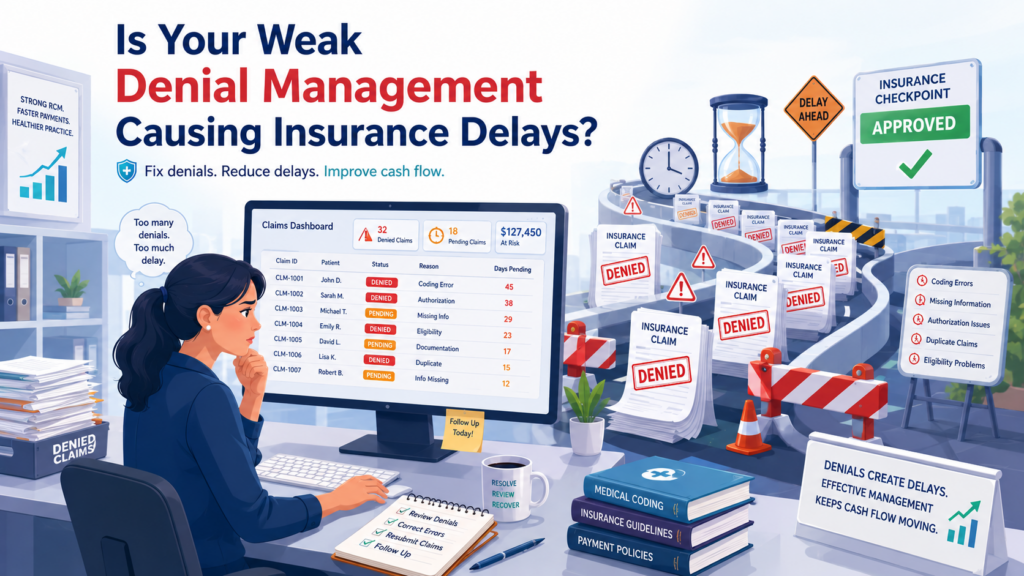
When an insurance company refuses to pay for a service, that is a denial. And managing what happens next- investigating it, correcting it, resubmitting it, and making sure it does not happen again- that is denial management. 4 in 10 providers say their claims are denied at least 10% of the time. And 90% of those denials require some level of human review. That means staff time, rework, follow-up, and delays every single day. The average cost of reworking a denied claim is $25 for providers and $181 for hospitals. Multiply that across hundreds of claims a month, and the numbers add up fast. And when denial management is weak or inconsistent, denied claims often remain unresolved for weeks or months. This leads to delayed reimbursements, increased write-offs, and revenue leakage that directly affect a practice’s financial health.
That’s why good denial management services are required, and if practices have the right systems in place, they can nearly recover two-thirds of the claims over MGMA, but it is also proven by AmFac Medical Management, which aggressively follows up and recovers up to 98%. Strong denial management follows four steps: identify the denial, manage the response, monitor the patterns, and prevent future occurrences. When all four work together, denials stop being a crisis and start becoming a manageable part of the revenue cycle.
When management for denial claims is weak, insurance delays are a guarantee. Because when a claim gets denied, someone from the team has to stop what they are doing, investigate the reason, correct the error, and resubmit. That process alone can take days. Then the payer reviews it again. And if anything is still missing, it comes back a second time. What should have been a 14-day payment cycle turns into 45, 60, or sometimes 90 days.
When these delays occur repeatedly, they create a backlog of unresolved claims that slows down the entire reimbursement process. Instead of receiving timely payments, practices are forced into a cycle of corrections, appeals, and resubmissions. Research shows that between 2022 and 2025, the proportion of providers reporting denial rates of at least 10% rose from 30% to 41%. Insurance delays grow more common as denial numbers increase, making it more difficult for clinics to keep a consistent reimbursement schedule.
Weak denial management in medical billing not only affects your revenue but it also affects your entire practice. And when it is weak, the damage does not stay contained to one department. It spreads across operations, staff, cash flow, and even patient relationships.
Let’s explore in detail how weak denial management affects your practice:
Severe Revenue Leakage and Write-Offs: When a practice cannot correct and resubmit denials on time, unpaid claims become permanent losses. Unresolved denials alone can cause providers to write off up to 3–5% of their net income. And every delayed reimbursement makes it harder to cover basic operating expenses, staff salaries, rent, and medical supplies.
In such cases, to prevent revenue leakage, the best way is to outsource medical billing services and strengthen denial management through the best medical billing company in the USA, like AmFac Medical Management. They investigate denied claims and resubmit them with corrections or appeals immediately, ensuring your internal team does not have to chase them. Claims are reviewed for accuracy and submitted clean the first time, reducing rework from the start. And unlike writing off unpaid claims or sending them to a hard-core collection agency where your practice loses 35–50% of the claim value, AmFac MM works every single account until it is resolved. No claim is written off without your consent. Internal costs are reduced by as much as 30%, and collection costs by as much as 50%, allowing your staff to focus more on patient care instead of paperwork.
Poor Patient Experience: Denial mismanagement does not stay behind the scenes. It shows up in confusing Explanation of Benefits statements, unexpected bills, and billing disputes. When patients cannot understand what they owe or why, trust erodes, and that is very hard to rebuild.
High Rework and Administrative Costs: Reworking a single denied claim can cost anywhere between $25 and $118, depending on its complexity. When denial trends are not monitored and appeal deadlines are missed, these costs can quickly add up. At the same time, front- and back-office staff often spend valuable hours investigating denials, correcting claims, and communicating with insurance companies, increasing administrative burden and contributing to staff burnout.
Partnering with the best medical billing company, such as AmFac Medical Management, can help reduce this workload by providing proper denial management services like handling claim follow-ups, denial resolution, appeals, and reimbursement tracking. The team works proactively to identify recurring denial patterns and address the underlying causes, helping practices improve claim acceptance rates over time. This allows healthcare providers and their staff to spend less time on billing-related tasks and more time focusing on patient care and practice operations.
Escalating Future Denials: Without root-cause analysis, the same errors keep repeating. Missing pre-authorizations, outdated codes, unverified insurance- these issues do not fix themselves. A weak denial process means your practice is always reacting instead of preventing. First-pass rates stay low, and the denial cycle never breaks. AmFac MM tracks denial patterns, identifies root causes, and fixes the process, so the same errors stop happening.
Denied claims can haunt your practice more than you think. If your denial management is weak, it can cost your practice revenue, time, patient trust, and create even bigger problems in the future. That is why having the right system, such as AmFac Medical Management, is important. Effective denial management in medical billing can identify errors early, resolve denials quickly, and prevent the same mistakes from recurring. This helps protect your revenue, reduces administrative burden, and allows your practice to focus on what matters most: your patients.
Insurance claim denials can occur for several reasons, including incorrect patient information, coding errors, missing or incomplete documentation, lack of prior authorization, duplicate claims, coverage limitations, or failure to meet payer-specific requirements. Identifying and addressing these issues quickly is an important part of effective denial management.
Denial management is important for medical practices because it helps medical practices recover revenue, reduce payment delays, and maintain healthy cash flow. Effective denial management also minimizes the time and cost spent correcting and resubmitting denied claims.
Collect visitor’s submissions and store it directly in your Elementor account, or integrate your favorite marketing & CRM tools.
Privacy Policy
Your privacy is very important to us. This Privacy Policy explains how we collect, use, and protect your information when you interact with our services, website, or communications.
Information We Collect
We may collect personal information that you provide directly to us, including but not limited to:
How We Use Your Information
We use the information we collect to:
Information Sharing
We do not sell or share your personal information with third parties for their marketing or promotional purposes.
No mobile information will be shared with third parties/affiliates for marketing/promotional purposes. All the above categories exclude text messaging originator opt-in data and consent; this information will not be shared with any third parties.
SMS Disclaimer
By providing your telephone number and submitting a form on our website or through other channels, you consent to receive SMS text messages from us.
Data Security
We use reasonable safeguards to protect your personal information from unauthorized access, disclosure, alteration, or destruction.
Updates to This Privacy Policy
We may update this Privacy Policy from time to time. Any changes will be posted on this page with an updated effective date.
Contact Us
If you have any questions about this Privacy Policy or our SMS practices, please contact us:
AmFac Medical Management
info@amfacmm.com
+1(877) 443-3655